🌺 Hathor Temple · Zodiac Ceiling · Ancient Healing · Dendera · From Hurghada/Luxor · Daily
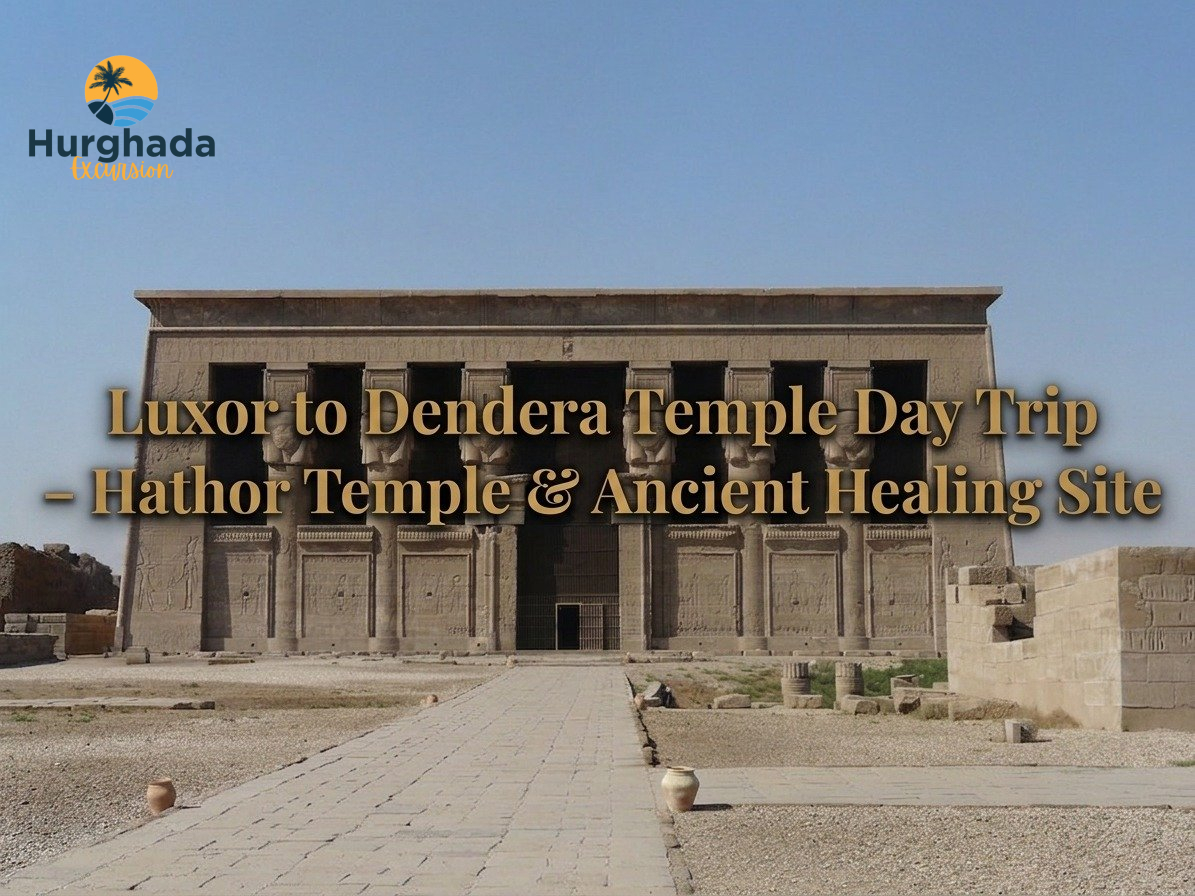
Luxor to Dendera Temple Day Trip – Hathor Temple & Ancient Healing Site
📅 Updated: May 2026 | ⏱️ Full Day from Hurghada · Half-Day from Luxor | 💶 From €85 / person | ⭐ 4.9/5 Rated | 🌺 Daily Departures
Sixty kilometres north of Luxor, on the west bank of the Nile in the ancient city of Qena, stands one of the most complete, most beautifully preserved, and most architecturally overwhelming temples in all of Egypt. The Temple of Hathor at Dendera is a Ptolemaic masterpiece — built between approximately 54 BCE and 60 CE by the last Greek-speaking rulers of Egypt and the first Roman emperors — and its scale, its colour, and the extraordinary mystery of its astronomical ceiling, its underground crypts, and its rooftop sanctuaries create an experience that is completely unlike any New Kingdom temple and unlike anything else in the ancient world. The Luxor to Dendera Temple day trip is the most rewarding excursion available from the Luxor area — and one of the most undervisited extraordinary monuments in Egypt.
The Hathor Temple at Dendera is also known as the Ancient Healing Site — because the Dendera complex contained one of the most important sanatoriums (healing centres) in the ancient world, where the sick came to seek cures through the intervention of the goddess Hathor. The sacred lake, the birth house (mammisi), the sanatorium building, the ritual incubation rooms, and the crypts beneath the temple are all part of an integrated healing complex that served as Egypt’s most celebrated centre of divine medicine for centuries. Understanding Dendera as both a religious monument and a functioning healing institution transforms the visit from temple tourism into an encounter with ancient medicine.
🌺 Where is the Temple of Hathor located? The Temple of Hathor at Dendera is located in the town of Dendera (ancient Iunit), on the west bank of the Nile approximately 60 km north of Luxor (75 km from Luxor city centre by road). It is the capital temple of the sixth nome (administrative region) of Upper Egypt and the primary cult centre of Hathor — the goddess of love, beauty, music, fertility, and healing. The complex covers approximately 40,000 square metres and includes the main Hathor Temple (the largest and best-preserved building), two birth houses (mammisi), the Sacred Lake, a sanatorium, an Isis chapel, and a Roman-period kiosk. The distance from Luxor to Dendera Temple is approximately 60 km — approximately 1 hour by road.
What Is Dendera Temple? History, Goddess & Significance
The Dendera Temple Complex — centred on the Temple of Hathor — is one of the best-preserved ancient Egyptian religious complexes. While most famous Egyptian temples date from the New Kingdom (1550–1070 BCE), Dendera’s main temple was built primarily during the Ptolemaic and early Roman period (54 BCE – 60 CE) — making it one of the youngest major Egyptian temples, yet it incorporates traditions, astronomical knowledge, and religious symbolism accumulated over 2,000 years of Egyptian civilisation.
The site of Dendera has been sacred to Hathor since at least the Old Kingdom (c. 2686 BCE) — 2,500 years before the current temple was built. The existing temple complex was begun under Ptolemy XII (father of Cleopatra), continued under Cleopatra VII herself, and completed under the Roman emperors Augustus, Tiberius, Claudius, and Nero. The extraordinary preservation of the complex — particularly the interior ceilings, which retain their original deep blue-black paint with gold astronomical decoration — is due partly to its relative remoteness from the major tourist routes and partly to the protective sand burial that preserved the interior spaces for millennia.
| Detail |
Information |
| Location |
West bank of the Nile, Dendera (ancient Iunit), 60 km north of Luxor |
| Dedicated to |
Hathor — goddess of love, beauty, music, fertility, and healing |
| Construction period |
c. 54 BCE – 60 CE (Ptolemaic–Roman) · site sacred since c. 2686 BCE |
| Key builders |
Ptolemy XII, Cleopatra VII, Augustus, Tiberius, Claudius, Nero |
| Complex size |
~40,000 m² — main temple + mammisi + sacred lake + sanatorium + Isis chapel |
| Distance from Luxor |
~60 km by road (approximately 1 hour) |
| Distance from Hurghada |
~320 km by road (approximately 3.5–4 hours) |
| Entry ticket (2026) |
~600 EGP (~€11) per adult — included in tour price |
| Opening hours |
07:00 AM – 05:00 PM daily |
Top 10 Highlights of the Dendera Temple Day Trip
⭐
1. The Hypostyle Hall — Hathor-Column Capitals
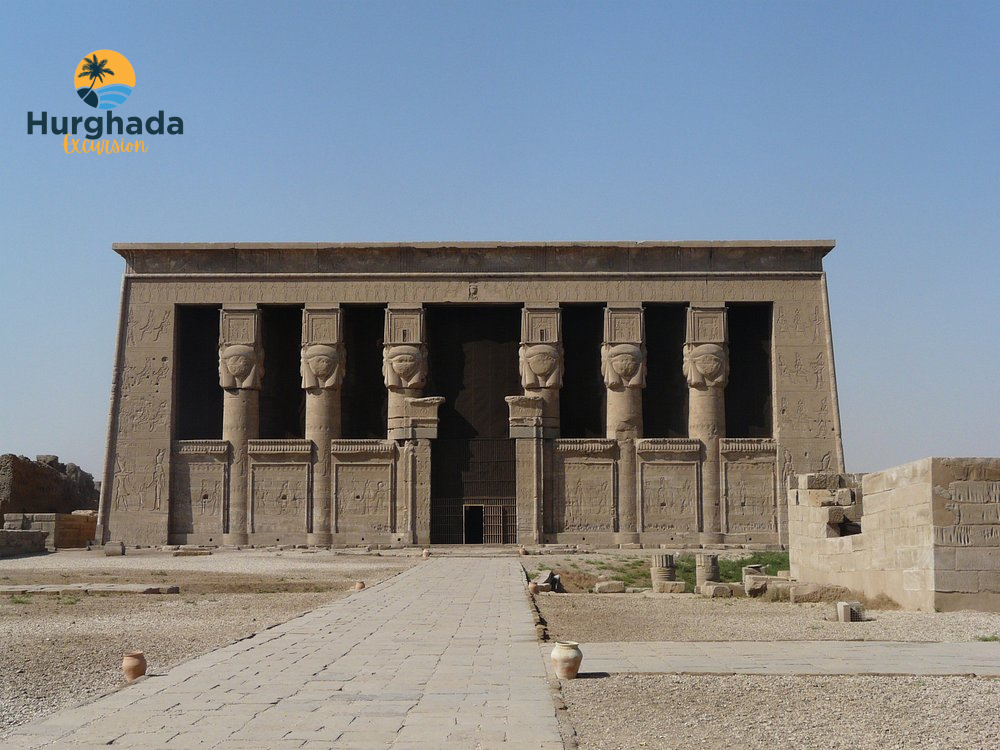
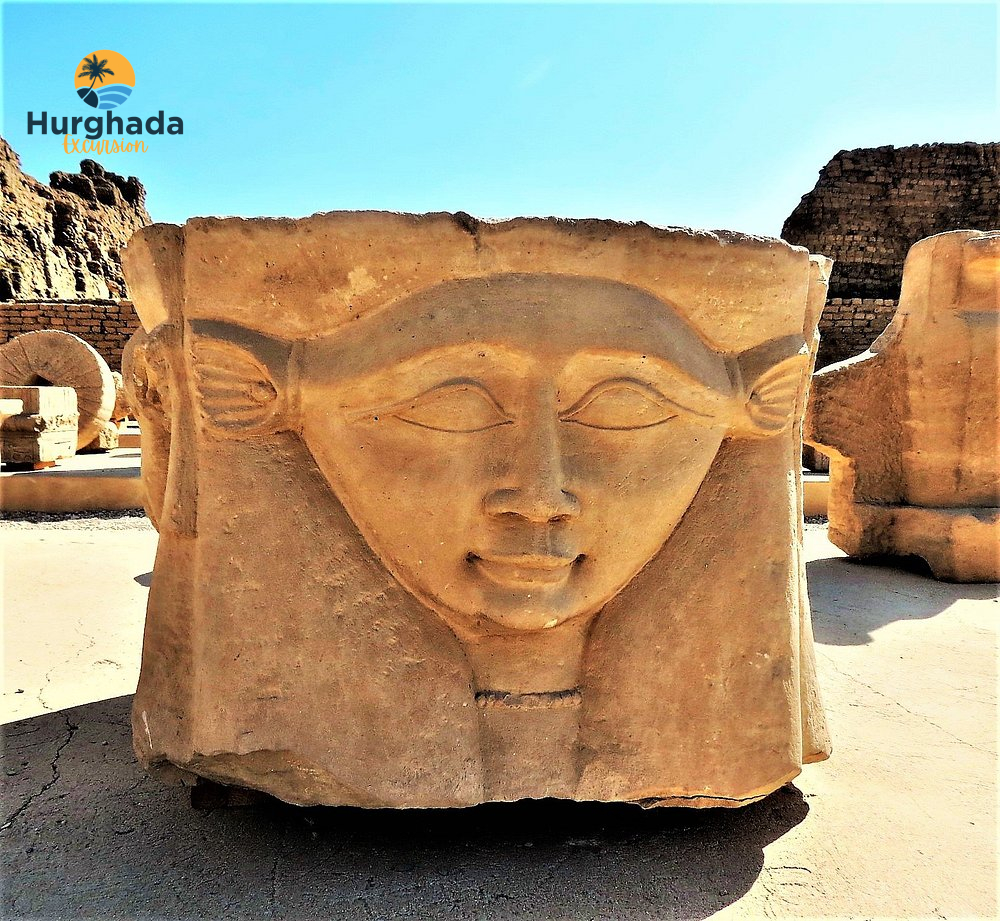
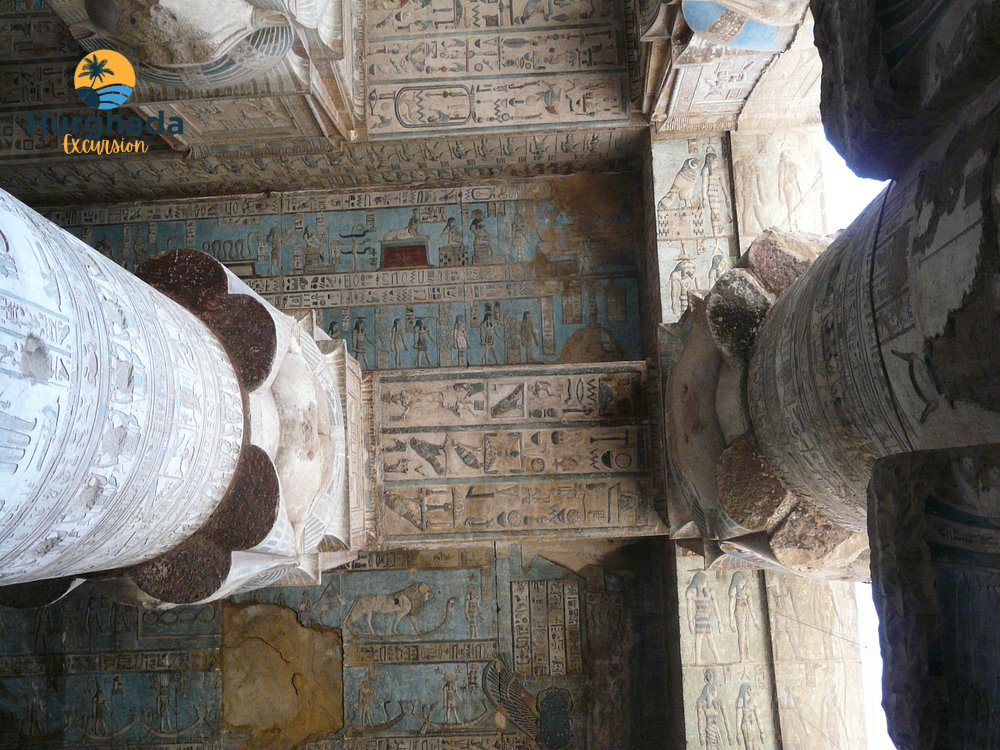
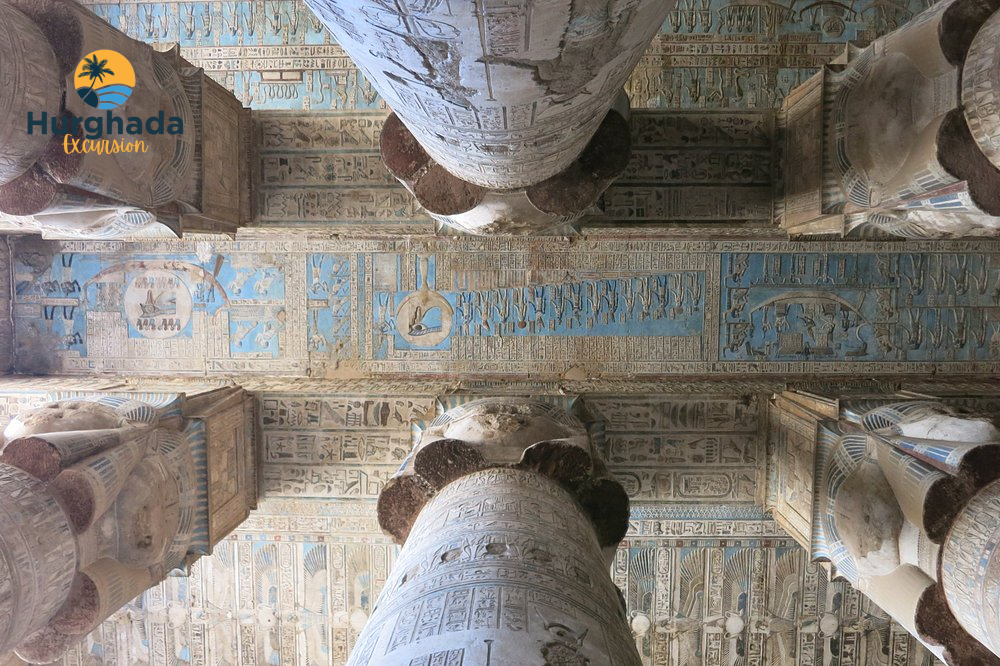
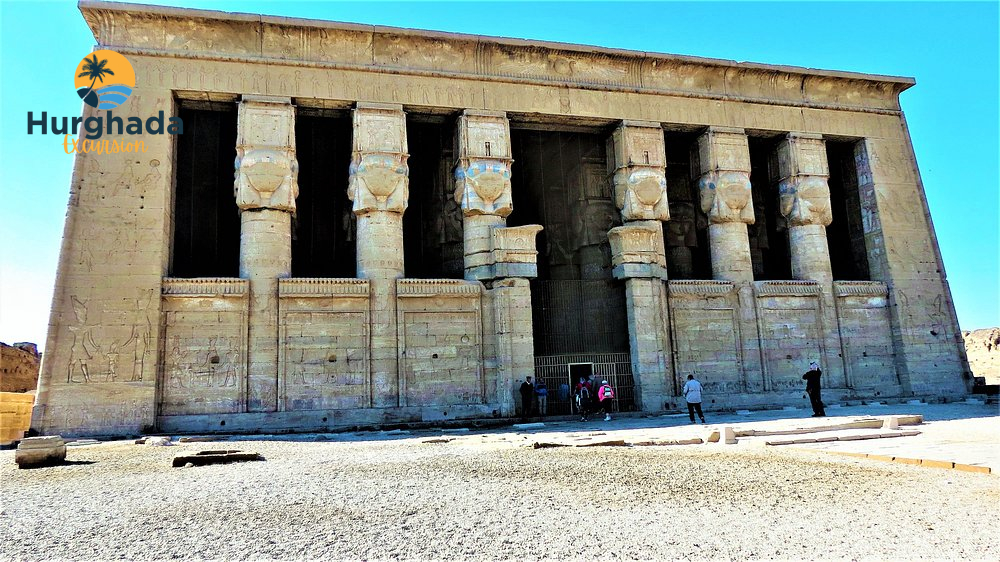
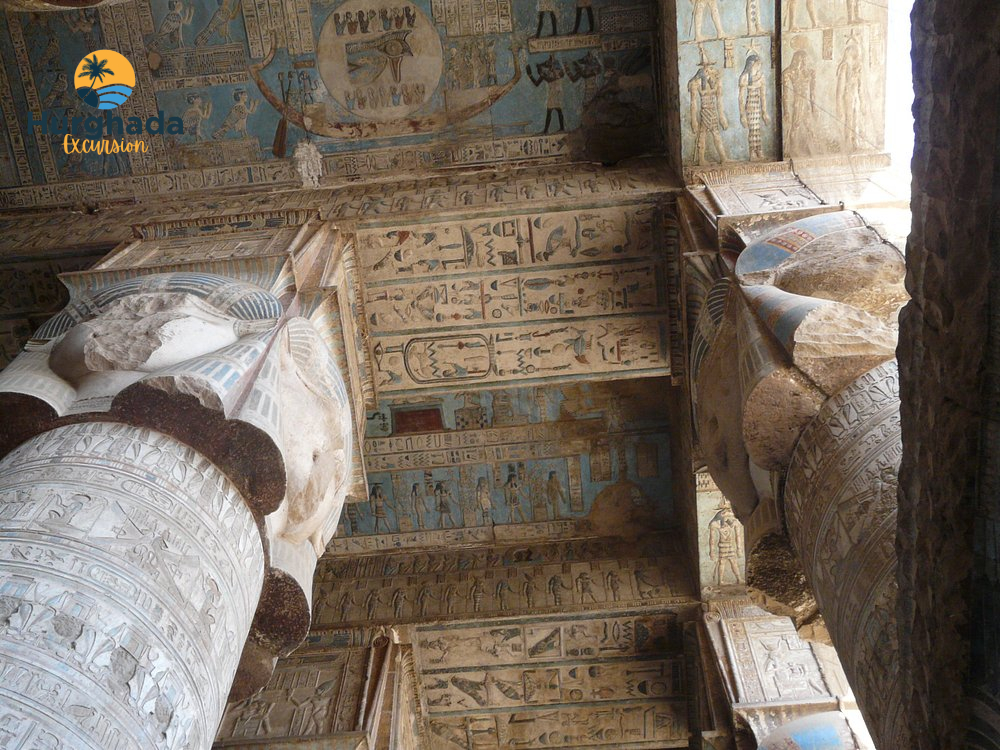
The entrance hypostyle hall — 24 columns, each topped with a capital carved as a four-faced Hathor head — is one of the most visually striking architectural spaces in ancient Egypt. The columns are massive, the ceiling is deep blue-black with golden astronomical reliefs, and the Hathor faces look out in all four directions with an expression of serene divinity that stops every visitor who sees them for the first time.
🌌
2. The Dendera Zodiac Ceiling — Ancient Astronomy
The rooftop Osiris chapel ceiling bears the most famous astronomical image in ancient Egypt — the Dendera Zodiac. This extraordinary circular star map shows all 36 decans of the Egyptian astronomical calendar, the 12 zodiac constellations (showing early contact with Greek astronomical tradition), planets, and seasonal markers. The original was removed by Napoleon’s expedition and replaced with a cast — but the ceiling of the main hypostyle hall still retains its vivid original astronomical decoration.
🏥
3. The Ancient Healing Sanatorium
The Dendera complex included a purpose-built sanatorium where the sick came to seek divine healing from Hathor — lying in ritual incubation chambers, bathing in waters that had passed over sacred statues, and seeking dream visitations from the goddess. This ancient healing centre was the Egyptian equivalent of a sacred hospital, operating for centuries and visited by the sick from across Egypt and the Mediterranean world.
🕳️
4. The Underground Crypts
Beneath the Hathor Temple, a network of underground crypts — accessible through narrow hidden doorways in the wall faces — stored the temple’s most sacred and most valuable objects: cult statues, ritual equipment, and the mysterious “power objects” associated with Hathor’s most secret ceremonies. The crypt walls bear the finest painted relief carvings in the entire complex — and contain the controversial “light bulb” relief that has generated decades of alternative history speculation.
🏛️
5. Cleopatra’s Cartouche on the Rear Wall
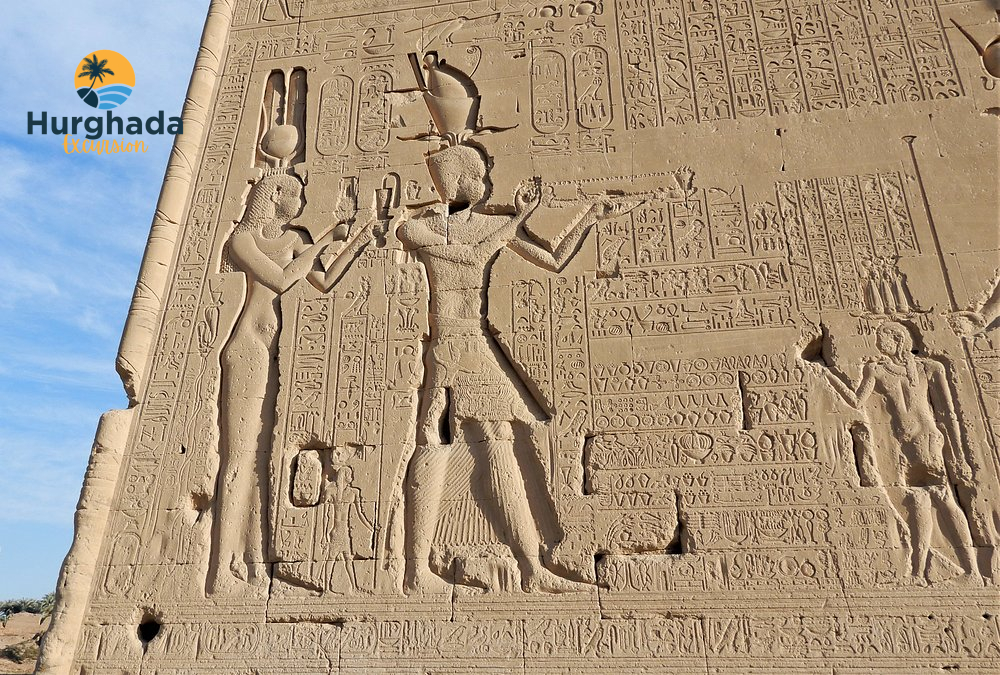
The monumental rear exterior wall of the Hathor Temple carries one of the most remarkable images in Egyptian history: the 14-metre-tall carved figure of Cleopatra VII — the last pharaoh of ancient Egypt — standing beside her son Caesarion (fathered by Julius Caesar). This is one of only a handful of surviving monumental images of Cleopatra anywhere. The guide stands at the base of the wall and tells the complete story of Egypt’s most famous queen.
🌿
6. The Rooftop Sanctuaries — New Year Procession
The interior staircases of the Hathor Temple lead to the rooftop — the site of the annual New Year Festival when Hathor’s cult statue was carried up to the roof at dawn for the “union with the sun disc” ceremony. The rooftop chapels are decorated with scenes of this annual procession, and from the roof, the extraordinary panoramic view over the Nile Valley and the Dendera complex makes this one of the finest viewpoints in Upper Egypt.
💫
7. The Perfectly Preserved Ceiling Colours
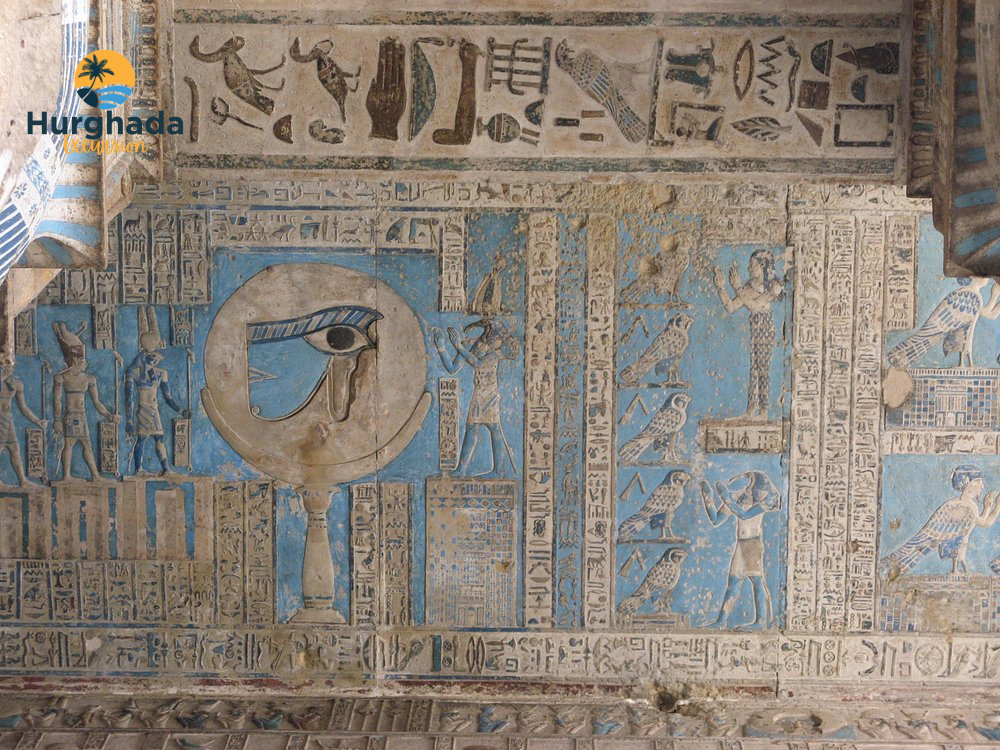
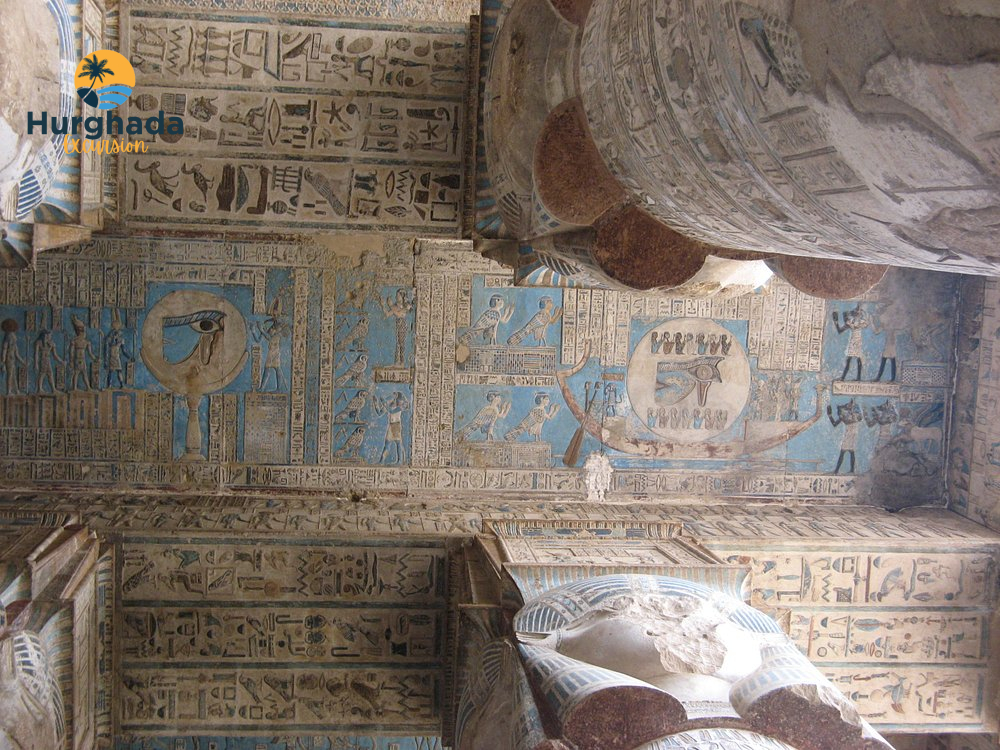
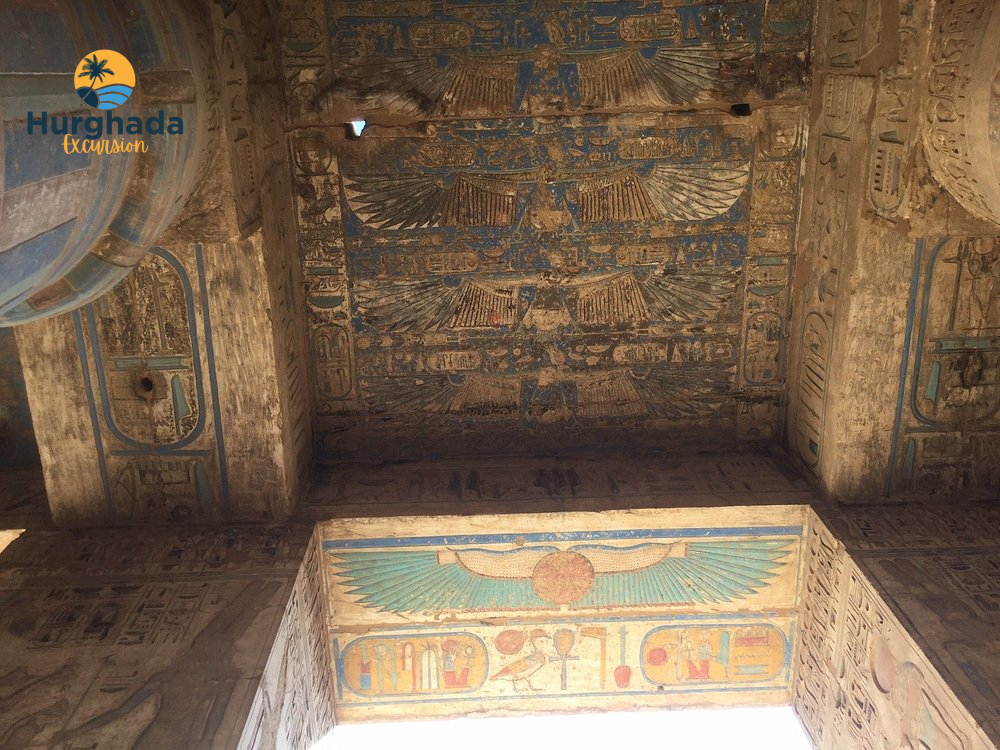
The interior ceilings of the Dendera Hathor Temple retain the most vivid and complete original polychrome decoration of any intact Egyptian temple — deep blue-black backgrounds with golden yellow hieroglyphs and astronomical symbols, ochre and turquoise figural scenes, and the extraordinary astronomical ceiling of the hypostyle hall. The preservation is due to centuries of sand burial that protected the interior from weathering and from the soot damage that afflicts most other temples.
🌊
8. The Sacred Lake
The rectangular Sacred Lake of the Dendera complex — used for ritual purification and the sacred boat processions of Hathor’s New Year Festival — is among the best-preserved sacred lakes in Egypt. Its stone-lined banks still retain their original stonework, and the surrounding landscape of the Dendera enclosure — with the Sacred Lake in the foreground and the temple facade behind — provides the most beautiful photographic composition in the complex.
🌸
9. The Mammisi — Birth Houses of Divine Kings
The Dendera complex contains two birth houses (mammisi) — ceremonial structures where the divine birth of the pharaoh (the child of Hathor and her consort Horus of Edfu) was celebrated annually. The Roman-period mammisi is one of the best-preserved birth houses in Egypt, with vivid painted reliefs on its screens. The guide explains how the mammisi functioned as the theological proof of the pharaoh’s divine legitimacy.
📸
10. The Most Photogenic Interior in Egypt
The Dendera Hathor Temple is consistently rated by professional photographers as the single most photogenic interior space in ancient Egypt — the combination of the Hathor-head column capitals, the deep blue-black ceilings with golden astronomical decoration, the vivid wall reliefs, and the extraordinary quality of the light entering through the clerestory windows creates photographic conditions that cannot be replicated at any other ancient site.
Complete Day Program — Hour by Hour from Hurghada & from Luxor
The Luxor to Dendera Temple day trip can be undertaken from either Hurghada (full day) or from Luxor (half day). Here is the complete program for both options:
🚐 OPTION A — FROM HURGHADA (Full Day · ~14–15 Hours)
Pickup at 04:00 AM · Road to Luxor: 3 hours · Arrive Luxor 07:00 · Karnak Temple optional (07:30–09:30) · Road to Dendera: 1 hour · Arrive Dendera 10:30 · Dendera Temple visit (10:30–13:00) · Lunch in Qena or on return (13:00–14:00) · Return to Luxor 15:00 · Optional Luxor Temple visit · Return road to Hurghada: 3 hours · Arrive Hurghada ~19:00 PM
🚐 OPTION B — FROM LUXOR (Half-Day · 4–5 Hours)
Pickup from Luxor hotel at 08:00 AM · Road to Dendera: 1 hour · Arrive 09:00 · Full guided temple visit (09:00–12:30) · Return to Luxor 13:30 · Optional afternoon Luxor activity · Return hotel 14:00 PM
09:00 – 09:30 · Arrival at Dendera Complex
🌺 First Impressions — The Enclosure Wall & Gateway
Arrival at the Dendera complex — tickets purchased at the main entrance kiosk (~600 EGP per adult — included in tour price, card payment only). The guide delivers the orientation briefing from just inside the main gateway: pointing out the different structures within the enclosure — the main Hathor Temple ahead, the Roman-period birth house to the left, the older Nectanebo birth house to the right, the Sacred Lake beyond, and the Isis chapel on the far side. The immediate impression — a large, well-preserved complex in a quiet agricultural setting without major tourist infrastructure — is one of the most genuinely atmospheric arrivals at any Egyptian site.
09:30 – 10:30 · Hypostyle Hall
🌺 The Great Hypostyle Hall — Hathor Capitals & Astronomical Ceiling
Entering the main Hathor Temple through the monumental facade — 24 columns in two rows, each topped with a four-faced Hathor-head capital — is one of the most immediately striking moments of any Egyptian temple visit. The guide spends approximately 30–40 minutes in the hypostyle hall, explaining the layout of a Ptolemaic temple (different in several key respects from New Kingdom design), the significance of the Hathor capitals, and the content of the astronomical ceiling — identifying the Dendera zodiac section (a copy, since the original was removed to Paris), the decans, the planets, and the seasonal mythology depicted.
Photography note: The hypostyle hall is the single most photogenic space in the Dendera Temple — the rows of Hathor-head capitals receding toward the inner sanctuary, with the deep blue-black ceiling above and the golden hieroglyphic decoration catching the available light, produce one of the finest architectural photographs available at any Egyptian site. Allow your eyes to adjust from the bright exterior before beginning to photograph — the interior requires 2–3 minutes of dark adaptation.
10:30 – 11:00 · Inner Sanctuary & Hall of Offerings
🕯️ Inner Sanctuary — The Sacred Naos of Hathor
Moving through the progressively smaller and darker inner halls — the Hall of the Ennead, the Hall of Offerings, the Hall of the Great Seat — toward the innermost sanctuary where Hathor’s sacred barque was housed. The guide explains the spatial theology of Egyptian temples: the temple is a model of the cosmos, with the outermost hall representing the outer world, the hypostyle hall representing the sky, and the inner sanctuary representing the primordial mound of creation where the god dwells. Entering the sanctuary is entering the moment of creation.
11:00 – 11:30 · Underground Crypts
🕳️ The Dendera Crypts — Sacred Storage & Mystery Reliefs
The hidden staircases descending into the subterranean crypts beneath the temple — narrow passages connecting chambers where the temple’s most sacred objects were stored between festivals. The crypt walls bear the finest quality painted relief work in the entire complex — including the famous “Dendera light bulb” relief that has generated enormous controversy. The guide explains both the archaeological interpretation and the alternative history theories, then delivers the scholarly consensus.
11:30 – 12:00 · Rooftop Chapels
🔝 The Temple Roof — Zodiac Chapel & Panoramic View
The interior staircase leads up through the temple walls to the rooftop chapels — the site of the annual New Year Festival procession. The Osiris chapel rooftop contains the base of the astronomical ceiling where the original Dendera Zodiac was carved (removed by Napoleon’s expedition and now in the Louvre; replaced here with a plaster cast). From the roof, the complete Dendera complex is visible below — Sacred Lake, birth houses, Isis chapel, and the agricultural plain of the Nile Valley extending to the horizon.
12:00 – 12:30 · Cleopatra Wall, Sacred Lake & Mammisi
👑 Cleopatra & Caesarion · Sacred Lake · Birth Houses
The exterior programme: the monumental rear wall of the temple with the carved figures of Cleopatra VII and Caesarion (the guide delivers the complete Cleopatra story here), the Sacred Lake with its beautifully preserved stonework and surrounding palm trees, and the Roman-period mammisi (birth house) with its fine painted column screens. The guide explains the theology of the mammisi — how the divine birth of the king was celebrated annually, renewing his divine legitimacy.
12:30 – 14:00 · Lunch & Return
🍽️ Lunch · Optional Abydos or Luxor Extension · Return
Lunch at a restaurant in Qena city (5 minutes from the temple site) or on the road back to Luxor. For the combined Dendera and Abydos tour, the afternoon continues to Abydos (60 km south of Dendera, see Section 10 below). For the standard Dendera-only programme, the return journey to Luxor (1 hour) departs after lunch.
Hathor — Goddess of Love, Beauty, Music & Healing
Understanding Hathor is essential to understanding Dendera. She is one of the oldest, most complex, and most widely worshipped deities in the entire Egyptian pantheon:
🌺
Who Is Hathor?
Hathor is one of the oldest Egyptian deities — worshipped from at least the Old Kingdom (c. 2686 BCE). She embodies love, beauty, music, dance, fertility, motherhood, foreign lands, mining, and — most relevantly at Dendera — healing. She is depicted as a woman with cow horns holding the solar disc, or as a cow, or (as at Dendera) as a woman with cow ears. She is the patron deity of the Nile Valley agricultural cycle and of the Egyptian afterlife.
🎵
Hathor & Music
Hathor is the patron of music — specifically the sistrum (a sacred rattle) and the menat necklace, both of which appear throughout the Dendera reliefs. The sound of the sistrum was believed to drive away evil spirits and summon the goddess’s healing presence. At Dendera, the annual Hathor festival involved music, dancing, and communal celebration visible in the reliefs of the hypostyle hall exterior.
🏥
Hathor & Healing
At Dendera, Hathor was specifically worshipped as a healing deity — and the complex provided both spiritual and practical medical services. The sanatorium building (adjacent to the main temple) allowed the sick to undergo incubation (ritual sleep seeking healing dreams), to bathe in waters charged with healing power by having been poured over sacred statues, and to receive treatments from the temple’s priest-physicians.
💑
Hathor & the Beautiful Festival of the Valley
The most important religious event at Dendera was the annual Beautiful Festival of Hathor’s Meeting with Horus — when Hathor’s sacred barque was carried north from Dendera to Edfu (180 km upriver) to meet Horus of Edfu in a sacred marriage festival lasting 14 days. This divine union renewed the fertility of the land and the divine legitimacy of the pharaoh. The complete reliefs of this festival are preserved in the Edfu Temple.
Complete Temple Sections — Every Part of Dendera Explored
The Dendera Temple complex is a complete ancient Egyptian religious precinct — far more than just the main temple. Here is a section-by-section guide to every structure:
🏛️
Main Hathor Temple
The primary temple — Ptolemaic-Roman period, begun c. 54 BCE and completed c. 60 CE. Complete with hypostyle hall, hall of appearances, hall of offerings, hall of the great seat, inner sanctuary, 12 side chapels, staircase towers, underground crypts, and rooftop chapels. The most complete and best-preserved temple building of its period in Egypt.
👶
Roman Mammisi (Birth House)
The Roman-period birth house stands immediately outside and to the south of the main temple entrance — one of the best-preserved mammisi in Egypt. Its columned screens are decorated with scenes of the divine birth of the pharaoh as the son of Hathor. The Roman emperor’s cartouche appears in some of the later reliefs, demonstrating how Roman emperors presented themselves in the traditional pharaonic format.
🏰
Nectanebo Birth House (Older Mammisi)
The older birth house built by Nectanebo I (30th Dynasty, c. 380–362 BCE) — predating the main temple by 300+ years. Its ruins show how the birth house tradition developed over time, and the remnants of its painted decoration provide a valuable comparison with the Roman-period mammisi beside it.
🏥
The Sanatorium
The purpose-built healing centre attached to the main temple enclosure — a series of chambers where the sick underwent healing rituals including incubation (ritual sleep in which the goddess was expected to visit in a dream and reveal the cure), ritual bathing, and treatment by priest-physicians. The Dendera sanatorium was one of the most celebrated healing centres in the ancient Mediterranean world.
🌊
Sacred Lake
The rectangular Sacred Lake in the eastern section of the enclosure — used for the ritual purification of priests before temple duties, for the sacred boat processions during festivals, and as the source of the healing waters used in the sanatorium. The lake is surrounded by palm trees and retains its original stone lining — creating an extraordinarily beautiful enclosed garden space within the temple enclosure.
✝️
Isis Chapel & Roman Kiosk
At the northwestern corner of the enclosure, a standalone chapel dedicated to Isis — Hathor’s sister deity in Egyptian mythology — with its own painted reliefs. A small Roman-period open kiosk (a freestanding columned structure) stands near the main gate — one of the best-preserved Roman-period temple structures in Egypt, decorated with reliefs of the emperor making offerings to Egyptian deities.
The Dendera Zodiac Ceiling — Ancient Astronomy Explained
The Dendera Zodiac is the most famous single image from Dendera Temple — a circular star map carved on the ceiling of the rooftop Osiris chapel, now in the Louvre (with a plaster cast at the original location). Here is the complete guide:
🌌 The Dendera Zodiac — What It Shows
The Dendera Zodiac ceiling is a sandstone circular bas-relief approximately 2.5 metres in diameter, carved c. 50 BCE. It is the oldest known complete horoscope of the Western zodiac tradition and provides extraordinary evidence for the cross-cultural exchange between Egyptian and Greek astronomical systems during the Hellenistic period.
The zodiac shows: the 36 decans of the traditional Egyptian calendar (each decan is a 10-day period marked by the heliacal rising of a specific star group); the 12 zodiac constellations of Greek tradition (Aries, Taurus, Gemini, etc.), shown in recognisable Greek iconographic form; the 5 visible planets (Venus, Mercury, Mars, Saturn, Jupiter) depicted as deities in specific positions; and seasonal markers including the summer solstice, winter solstice, and equinoxes.
The zodiac was carved in September 50 BCE according to modern astronomical analysis — a date consistent with the temple’s construction period under Cleopatra and her co-regent Ptolemy XIII. It was removed by Napoleon’s expedition in 1820 and now hangs in the Louvre in Paris (Room 327). The ceiling of the main hypostyle hall — which the guide focuses on in preference — still retains its original astronomical decoration and provides a more complete and visually accessible explanation of ancient Egyptian astronomical knowledge.
The Ancient Healing Site — Sanatorium, Sacred Lake & Divine Medicine
The Dendera ancient healing site was one of the most celebrated medical sanctuaries in the ancient world. Here is the complete guide to how it functioned:
🌙
Incubation Healing
Patients would sleep in designated chambers of the sanatorium, seeking healing dreams in which the goddess Hathor would appear and reveal the appropriate treatment. This practice — known as incubation or enkoimesis — was common throughout the ancient Mediterranean world (practiced at Epidaurus in Greece, Pergamon in Anatolia, and other healing sanctuaries) and at Dendera represented the specifically Egyptian form of divine medicine.
💧
Sacred Water Healing
Water poured over sacred statues — particularly over the healing statues of Horus-on-crocodiles (cippi) and other protective deities — was believed to absorb the magical healing properties of the deity and was then drunk or applied to the patient’s body. The Dendera sanatorium had specific channels and basins for the collection and distribution of this charged healing water.
📜
Medical Papyri & Priest-Physicians
The Dendera temple complex housed a library of medical papyri and employed a staff of priest-physicians — specialists in both ritual medicine and practical medicine. The distinction between “religious” and “medical” treatment did not exist in ancient Egyptian thought: the deity’s intervention and the physician’s expertise were complementary rather than competing approaches to healing.
🌿
Herbal & Ritual Medicine Combined
The Dendera healing tradition combined herbal remedies, surgical techniques, dietary regulation, and ritual/magical procedures in an integrated system. The temple’s agricultural estates (depicted in the storeroom reliefs) produced the medicinal plants and provisions needed both for the temple’s religious functions and its healing services.
The Dendera Crypts & Underground Passages
Beneath the Dendera Hathor Temple, a network of underground crypts runs beneath the outer corridor walls — 12 crypts in total, accessible through hidden doorways cut into the wall faces at floor level. Here is what they contain:
📦
Purpose of the Crypts
The crypts served as sacred storage areas for the temple’s most important ritual objects — the ba statues of Hathor (portable cult images used in festival processions), the temple’s sacred equipment, and the “power objects” associated with the most esoteric ceremonies. The objects were brought out only during specific festivals. The rest of the time, the crypts were sealed.
🎨
Finest Relief Carvings
Because the crypts were never exposed to the public and received virtually no visitors in antiquity (only the senior priests could enter), their relief carvings were carved with the finest quality workmanship in the entire temple. The narrow crypt passages contain some of the most delicate and beautifully detailed relief work anywhere at Dendera — including the controversial “light bulb” image in Crypt 1.
💡
The “Light Bulb” Relief
In Crypt 1 of the southern crypts, a relief carving has been interpreted by alternative history enthusiasts as depicting an ancient electric light bulb. The scholarly interpretation: it shows a djed pillar (a stability symbol associated with Osiris) with a lotus flower emerging from it and a serpent inside — a standard Egyptian mythological combination with no technological reference. The guide explains both interpretations. The crypt is accessible and the guide points out the specific image.
The Dendera Temple Mystery — The Light Bulb Relief & Other Controversies
Dendera Temple mystery — the popular name for a cluster of alternative interpretations of specific carvings and features at Dendera that have generated enormous online discussion. Here is the scholarly position on each:
💡
The “Electric Light Bulb”
Alternative claim: A crypt relief shows an ancient electric light bulb, suggesting the Egyptians had electricity. Scholarly interpretation: The relief shows a djed pillar (the symbol of Osiris/stability) with a serpent emerging from a lotus within it — all standard Egyptian religious symbols with documented parallels elsewhere. There is no archaeological evidence for any electrical knowledge in ancient Egypt. The guide explains both positions and lets visitors draw their own conclusions.
🔬
The Dendera Zodiac & Precession
Alternative claim: The Dendera Zodiac encodes knowledge of the precession of the equinoxes dating back 36,000 years. Scholarly interpretation: Modern astronomical analysis dates the zodiac to 50 BCE based on the planetary positions shown, consistent with its known construction period. It shows impressive knowledge of Hellenistic Greek astronomy acquired through Ptolemaic cultural exchange — not ancient hidden knowledge.
😶
The Defaced Cleopatra Image
Why is the Cleopatra carving unfinished? The rear exterior wall carving of Cleopatra and Caesarion was begun but never completed — the pharaonic figures are carved but unfinished. This is consistent with the political context: work may have stopped after the suicide of Cleopatra in 30 BCE and the Roman conquest of Egypt. The guide explains this historical context in detail.
Optional Extension — Dendera & Abydos Temples from Luxor
The most popular upgrade to the Dendera Temple day trip is the combined Dendera and Abydos temples from Luxor tour — visiting both temples in a single day. Here is the complete information:
🏛️
What Is Abydos Temple?
The Temple of Seti I at Abydos is one of the most significant ancient Egyptian religious sites — the cult centre of Osiris (god of the dead) and the location of the famous Abydos King List, a carved sequence of all pharaonic names from the beginning of Egypt to Seti I’s reign. It is the most important historical document of ancient Egyptian chronology and one of the most beautifully decorated temples in Egypt.
📏
Luxor to Abydos Distance
Luxor to Abydos distance: approximately 130 km north of Luxor (about 2 hours by road). Abydos is approximately 60 km north of Dendera, making the combined Dendera and Abydos route a northward circuit from Luxor: Luxor → Abydos (2h) → Dendera (1h further north) → return to Luxor. Or alternatively in the opposite sequence. Total driving for the combined tour: approximately 6–7 hours.
⏱️
Combined Tour Duration
A full combined Dendera and Abydos temples from Luxor tour is a very full day — departing Luxor at 07:00 AM and returning by 18:00–19:00 PM. Both temples require approximately 2 hours each. With driving time and lunch, the combined tour is approximately 11–12 hours from Luxor. From Hurghada, the combined Dendera and Abydos tour is not recommended as a single day — the distances make it logistically very demanding.
💶
Combined Tour Price
The Dendera and Abydos combined tour from Luxor costs approximately €110–€130 per adult (private guide, vehicle, both entry tickets, lunch). From Hurghada, the combined tour adds approximately €20–€30 to the standard Dendera-only day trip price. Both Abydos Temple and Dendera Temple tickets are approximately 600 EGP each per adult.
Dendera Temple Ticket Price 2026 & Opening Hours
| Site / Ticket |
Price (EGP) |
Approx. EUR |
Notes |
| Dendera Temple Complex (Adult) |
~600 EGP |
~€11 |
Included in tour price · card only · open 07:00–17:00 |
| Dendera Temple (Student) |
~300 EGP |
~€6 |
Valid ISIC or university ID required |
| Abydos Temple (Adult) — optional |
~600 EGP |
~€11 |
Add-on for Dendera & Abydos combined tour |
| Photography fee (if charged) |
~100 EGP |
~€2 |
Sometimes charged for specific areas — guide advises |
Day Trip Price from Hurghada & Luxor 2026 — What’s Included
Luxor to Dendera Temple Day Trip — From
€85
per adult · Full day from Hurghada · Hathor Temple · Zodiac Ceiling · Ancient Healing Site
✓ Private Vehicle · ✓ Egyptologist Guide · ✓ Entry Ticket · ✓ Lunch · ✓ Water
From Luxor only (no Hurghada transfer): from €55 per adult · Children 4–11: 50% discount · Dendera + Abydos: from €110
✅ Included (Hurghada Package)
✓ Private air-conditioned vehicle: Hurghada – Luxor – Dendera – Hurghada (~320 km each way)
✓ Licensed Egyptologist guide for the full day at Dendera
✓ Dendera Temple Complex entry ticket (~600 EGP per adult)
✓ Optional morning visit to Karnak Temple or Valley of the Kings (before Dendera)
✓ Full lunch at a Luxor or Qena restaurant (soft drinks and water included)
✓ Bottled water throughout · Free cancellation 48 hours before
10 Expert Tips for Your Dendera Temple Visit
Tip 1 — Bring a powerful torch/flashlight for the crypts and the interior dark spaces. The underground crypts at Dendera have limited artificial lighting and the finest relief carvings (including the “light bulb” image) are in the darkest sections. A powerful flashlight illuminates both the crypt passages and the ceiling sections of the hypostyle hall that the available light does not fully reach. The guide will have a torch, but having your own means you can examine details independently.
Tip 2 — Allow your eyes to adapt before entering the hypostyle hall. The Dendera hypostyle hall is one of the darkest interiors in Egypt — the deep blue-black ceiling absorbs available light. After the bright exterior, stand in the entrance doorway for 2–3 minutes before entering. The extraordinary ceiling decoration emerges from the darkness progressively as your eyes adapt — the experience of it “appearing” is genuinely magical.
Tip 3 — Go up to the rooftop — it is one of the finest viewpoints in Upper Egypt. Most visitors to Dendera never discover the interior staircases leading to the rooftop. The panoramic view from the top of the Hathor Temple — the Sacred Lake below, the agricultural plain of the Nile Valley extending to the horizon, and the complete temple complex visible from above — is extraordinary. The rooftop Osiris chapel with the cast of the zodiac ceiling is also here.
Tip 4 — Ask the guide to explain the Cleopatra and Caesarion wall carving in full. The rear exterior wall of the Hathor Temple bears one of the most historically extraordinary carvings in Egypt — the last pharaoh of ancient Egypt depicted at full monumental scale with her son by Julius Caesar. The story of Cleopatra VII — her relationship with Caesar, her marriage to Mark Antony, the Battle of Actium, and her suicide — is one of the most compelling in ancient history, and the guide tells it in full at the base of the wall where her image was carved.
Tip 5 — The Dendera sanatorium is often overlooked — ask to visit it specifically. The sanatorium building (east of the Sacred Lake) is not always included in standard guided tours that focus exclusively on the main temple. Ask the guide to include it — it is one of the most genuinely unusual structures in any ancient Egyptian religious complex and provides the essential context for understanding Dendera as a healing site rather than merely a religious monument.
Tip 6 — Dendera is dramatically less crowded than Luxor sites — plan accordingly. The Dendera Hathor Temple receives perhaps 5–10% of the visitors that Karnak or the Valley of the Kings receive on any given day. Plan your visit accordingly — there is no need to arrive at opening time to beat the crowds. A mid-morning arrival (09:00–10:00 AM) provides excellent conditions throughout the visit.
Tip 7 — Photograph the Hathor-head capitals from the cella doorway looking back. Standing in the doorway of the inner sanctuary and looking back through the aligned hypostyle hall columns toward the entrance — the Hathor capitals receding in perfect symmetry, the astronomical ceiling above, the light entering from the facade beyond — is the single most dramatic architectural photograph available at Dendera. The guide will position you for this shot.
Tip 8 — The approach to Dendera by road is itself beautiful — look at the Nile Valley. The 60 km road from Luxor to Dendera runs through the Nile Valley agricultural plain — sugar cane fields, banana groves, date palm farms, and the flat-bottomed river valley between desert escarpments on both sides. This is one of the most beautiful stretches of the Upper Egyptian Nile Valley and worth experiencing with the vehicle window down on the return journey.
Tip 9 — The Dendera & Abydos combined tour is the finest single-day cultural experience in Upper Egypt. For guests with the time (ideally staying in Luxor for the logistics), the combined Dendera and Abydos day tour — Hathor at Dendera and Osiris at Abydos — visits the two most important cult centres of Egyptian theology in a single day. The contrasts are extraordinary: Dendera’s Ptolemaic-period completeness against Abydos’s New Kingdom sublimity; Hathor’s love and healing against Osiris’s death and resurrection. Ask about availability when booking.
Tip 10 — Dendera is the most satisfying temple for guests who have already seen all the famous Luxor sites. The classic Luxor programme covers Karnak, Valley of the Kings, and Hatshepsut Temple — all extraordinary but visited by millions annually. Dendera is visited by tens of thousands and provides an entirely different architectural tradition (Ptolemaic rather than New Kingdom), a different deity and theological focus, and a unique combination of astronomical, medical, and religious heritage that complements the famous Luxor sites perfectly.
Real Reviews from Travellers
★★★★★
“The most beautiful temple interior I have ever seen. The Hathor capitals, the deep blue-black astronomical ceiling, the perfectly preserved colours — nothing in Karnak or the Valley of the Kings comes close to the visual impact of the Dendera hypostyle hall. Our guide was extraordinary. The crypt visit with the famous ‘light bulb’ relief was fascinating. Do not miss this temple.”
Dr. Sarah M. — London · March 2026
★★★★★
“Standing beneath the Hathor-head columns in the near-darkness, with the golden astronomical ceiling emerging as my eyes adapted — genuinely one of the most beautiful architectural experiences of my life. The guide’s explanation of the healing site, the sacred lake, and the Cleopatra wall was perfect. The rooftop view over the complex is extraordinary. This should be on every Egypt itinerary.”
Robert K. — Edinburgh · February 2026
★★★★★
“We did the combined Dendera and Abydos tour from Luxor — the best single day of our entire Egypt holiday. Dendera for Hathor and the astronomical ceiling, Abydos for Osiris and the Seti I reliefs. The guide connected both theologically throughout the day. The sanatorium section at Dendera was one of the most fascinating things I have encountered at any ancient site anywhere in the world.”
Caroline & James W. — Bristol · January 2026
Frequently Asked Questions
Where is the Temple of Hathor located?
Where is the Temple of Hathor located? The Temple of Hathor at Dendera is located in the town of Dendera (ancient Iunit), on the west bank of the Nile in Qena Governorate, Upper Egypt — approximately 60 km north of Luxor by road (about 1 hour). It is the primary cult temple of the goddess Hathor and one of the best-preserved ancient Egyptian temple complexes in existence. Coordinates: approximately 26.1417°N, 32.6700°E.
What is the Dendera Zodiac ceiling?
The Dendera Zodiac ceiling is a circular bas-relief star map carved c. 50 BCE on the ceiling of the rooftop Osiris chapel of the Hathor Temple at Dendera. It shows the 36 Egyptian decans, the 12 Greek zodiac constellations, the 5 visible planets, and seasonal markers. It is the oldest known complete zodiac and provides evidence of Hellenistic Greek-Egyptian astronomical exchange during the Ptolemaic period. The original was removed by Napoleon’s expedition in 1820 and is now in the Louvre in Paris (Room 327). A plaster cast occupies the original ceiling position.
What is the ancient healing site at Dendera?
The Dendera ancient healing site refers to the purpose-built sanatorium attached to the main Hathor Temple complex — a series of chambers where the sick underwent ritual healing through incubation (dream-seeking sleep), bathing in sacred healing waters (charged by contact with divine statues), and treatment by the temple’s priest-physicians. Dendera was one of the most celebrated healing sanctuaries in the ancient Mediterranean world, attracting the sick from across Egypt and beyond for centuries.
What is the distance from Luxor to Dendera Temple?
Distance from Luxor to Dendera Temple: approximately 60 km by road (about 1 hour by private vehicle). From Hurghada, the total distance is approximately 320 km (3.5–4 hours by road). Dendera is located 60 km north of Luxor (upstream on the Nile, in the direction of Cairo). The road travels through the Nile Valley agricultural plain past the city of Qena.
What is the Luxor to Dendera Temple day trip price?
The Luxor to Dendera Temple day trip price starts from €85 per adult from Hurghada (including private vehicle, Egyptologist guide, temple entry, lunch, and water). From Luxor only (no Hurghada transfer), the price starts from approximately €55 per adult. The combined Dendera and Abydos temples from Luxor tour costs approximately €110–€130 per adult. Children 4–11 receive a 50% discount.
What is the Dendera Temple mystery (the light bulb relief)?
The Dendera Temple mystery refers primarily to a relief carving in one of the underground crypts that alternative history enthusiasts have interpreted as depicting an ancient electric light bulb. The scholarly interpretation: the image shows a djed pillar (the symbol of Osiris/stability) with a lotus flower and a serpent inside — standard Egyptian religious symbols with numerous parallels in Egyptian art. There is no archaeological evidence for electrical technology in ancient Egypt. The crypt is accessible during the guided tour and the guide explains both interpretations directly at the relief.
Book Your Luxor to Dendera Temple Day Trip Today
From €85 per person from Hurghada · From €55 from Luxor · Hathor Temple · Zodiac Ceiling · Ancient Healing Site · Egyptologist Guide · All Tickets · Lunch · Free Cancellation 48 Hours Before.
🌺 Book Now — From €85
The Luxor to Dendera Temple day trip delivers one of the most complete and most beautiful ancient Egyptian temple experiences available — a Ptolemaic-period masterpiece where the goddess of love, beauty, and healing was worshipped in a complex that combined religious ceremony, astronomical knowledge, medical practice, and theatrical sacred performance for centuries. The Hathor Temple at Dendera is the finest preserved example of its era, and the combination of its extraordinary architectural completeness, its vivid astronomical ceiling, its underground crypts, its rooftop zodiac chapel, its sanatorium healing centre, and the monumental image of Cleopatra VII on its rear exterior wall makes it unique among all the monuments of ancient Egypt.
Book your Dendera Temple day trip today with Hurghada Excursion — private vehicle, licensed Egyptologist, all entry tickets, and the most complete ancient healing site experience available from the Red Sea coast.