🌟 Stargazing · Bedouin Dinner · Eastern Desert · Camel Ride · Fire Show · Hurghada · Nightly
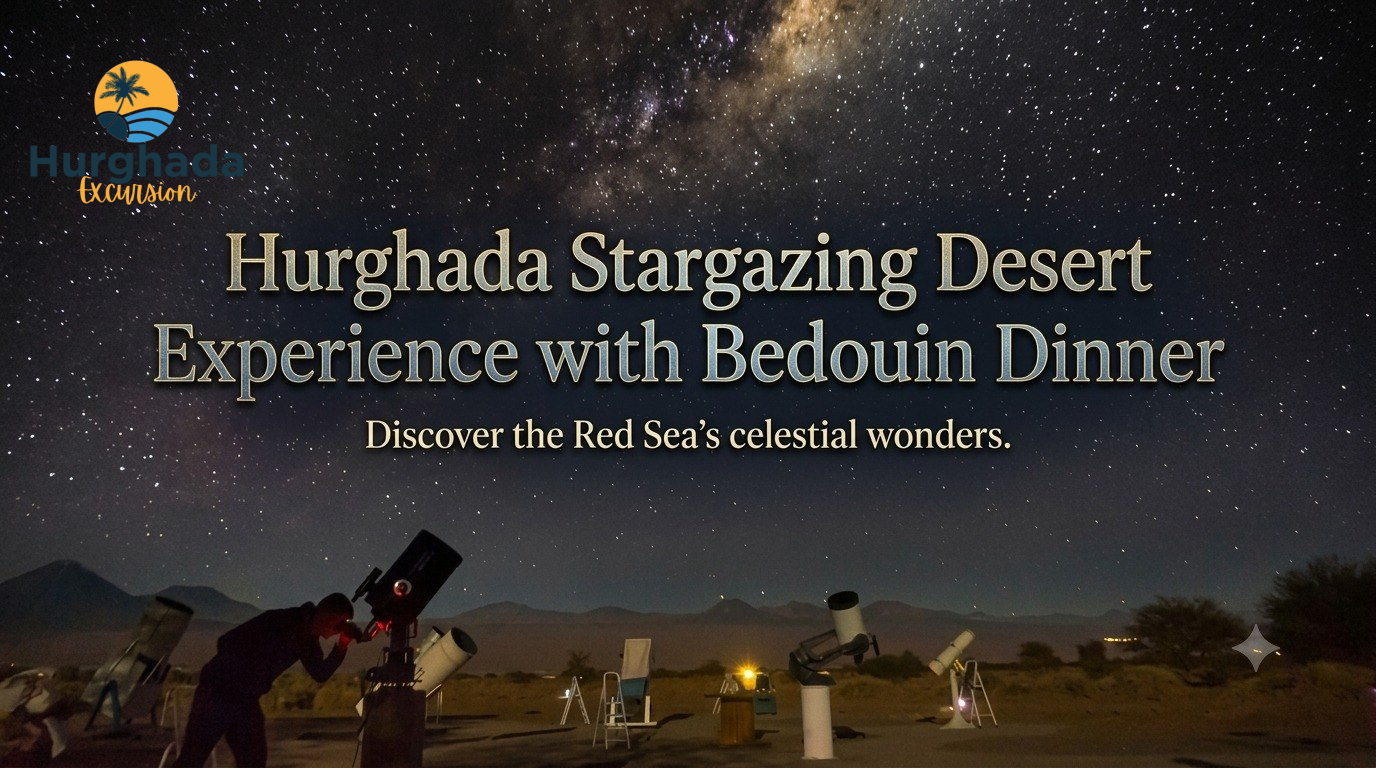
Hurghada Stargazing Desert Experience with Bedouin Dinner
📅 Updated: May 2026 | ⏱️ 4–5 Hours · Evening Departure | 💶 From €35 / person | ⭐ 4.9/5 Rated | 🌟 Nightly Departures
The Red Sea has kept tourists busy all day — the coral reef, the swimming, the sun deck, the snorkelling. But when the sun drops behind the Egyptian mountains and the last light fades from the horizon, the Eastern Desert east of Hurghada offers something that no beach, no boat, and no hotel pool can provide: one of the finest natural stargazing skies in North Africa, seen from a Bedouin desert camp where the ancient tradition of desert hospitality — sweet tea, open fire, camel rides at sunset, and a traditional Bedouin dinner under a handwoven tent — has been practised continuously for centuries. The Hurghada stargazing desert experience with Bedouin dinner is the most distinctively Egyptian evening available from the Red Sea coast — combining the extraordinary astronomy of the Sahara sky with the warmth, flavour, and fire of the desert hospitality tradition that has defined this landscape for thousands of years.
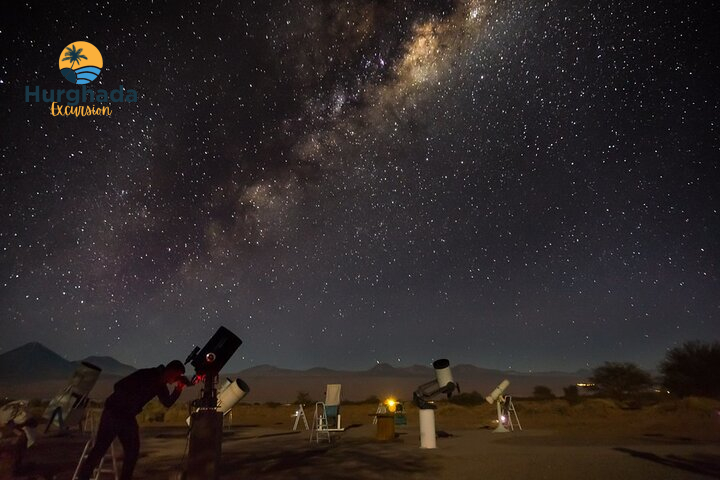
The Hurghada stargazing experience takes place approximately 30 km west of Hurghada in the Eastern Desert — far enough from the city’s light pollution to reveal the full glory of the Milky Way, the planets, and the deep-sky objects that are invisible from any hotel or resort. The professional astronomer guide uses a high-powered telescope to bring Saturn’s rings, Jupiter’s moons, and the craters of the Moon to intimate viewing distance, while explaining the mythology and science of the constellations visible overhead with a laser pointer against the desert sky. The Bedouin dinner — prepared over an open fire using traditional recipes passed through generations — provides the culinary and cultural heart of the evening: Egyptian flatbreads baked in the sand, slow-cooked lamb or chicken, mezze in clay bowls, and the ceremony of Bedouin tea that marks the beginning and end of every evening in the desert.
🌟 Why Is the Eastern Desert Near Hurghada Perfect for Stargazing? The Eastern Desert of Egypt — the zone between the Nile Valley and the Red Sea coast — has exceptional astronomical conditions: Bortle Class 2–3 sky darkness (meaning minimal light pollution — the same classification as the world’s premier observatory sites), 300+ clear nights per year (Egypt’s desert climate virtually eliminates cloud cover), extremely low atmospheric humidity (critical for star clarity — the dry desert air has almost no water vapour to scatter starlight), and complete absence of industrial air pollution. The combined result is a night sky of extraordinary quality — the Milky Way visible as a luminous band across the whole sky, thousands of stars visible to the naked eye, and the deep-sky objects (galaxies, nebulae, star clusters) observable through even a modest telescope with exceptional clarity.
| Detail |
Standard Experience |
Private VIP Experience |
| Duration |
4–4.5 hours |
5–6 hours (flexible) |
| Pickup Time |
Seasonal: 18:00–19:00 (summer) · 16:30–17:30 (winter) |
Customised to your schedule |
| Languages |
English · Arabic |
+ German · French · Russian · Italian (on request) |
| Group Size |
Up to 30 (shared) |
2–15 guests (private camp) |
| Min. Age |
All ages · Children welcome |
All ages · family VIP option available |
The Eastern Desert & Why the Sky Is Extraordinary
The Eastern Desert of Egypt stretches between the Nile Valley to the west and the Red Sea coast to the east — a 420,000 km² wilderness of limestone plateaus, granite mountains, and wadis (dry riverbeds) that receives almost no rainfall and supports almost no artificial light infrastructure outside the narrow coastal strip. This combination of extreme dryness, minimal light pollution, and desert elevation creates astronomical observation conditions that rival the world’s premier observatory sites.
Light Pollution Level
Bortle Class 2–3
The Bortle Scale measures sky darkness from 1 (darkest — pristine sky) to 9 (heavily light-polluted urban sky). The Eastern Desert near Hurghada rates Class 2–3 — the same classification as major international observatories. For comparison, Hurghada city centre rates Class 7–8. The 30 km drive into the desert produces a dramatic, immediate improvement in sky quality.
Sky Clarity
300+ Clear Nights Per Year
Egypt’s desert climate is one of the most reliably cloud-free on earth — the Eastern Desert has fewer than 20 cloudy nights per year. The stargazing experience is cancelled only in extraordinary weather events (strong sandstorm or unusual cloud cover) — rain at the desert camp site is an almost unknown phenomenon. This reliability is one of the most important practical advantages of Egypt’s desert astronomy.
Atmospheric Quality
Exceptional Seeing Conditions
The dry desert air (relative humidity 10–25%) has minimal water vapour — a critical factor in sky clarity, since atmospheric moisture scatters starlight and reduces telescope resolution. The Eastern Desert near Hurghada has exceptional “seeing” conditions — the technical term for atmospheric steadiness that determines telescope image quality. The combination of darkness, dryness, and stability produces views through the telescope that surpass those available at many permanent observatory installations.
Top 12 Highlights of the Hurghada Stargazing Bedouin Experience
🌌
1. The Milky Way in Full Visibility
The most overwhelming visual experience of the entire evening — arriving at the desert camp and stepping out of the vehicle to find the complete arc of the Milky Way visible above from horizon to horizon, a luminous band of hundreds of billions of stars so bright it casts a faint shadow on the desert sand. For guests who have only ever seen a handful of stars from a city sky, this moment — universal in the guest reviews as the most memorable of their Hurghada holiday — produces immediate and lasting awe.
🔭
2. Professional Telescope Observation
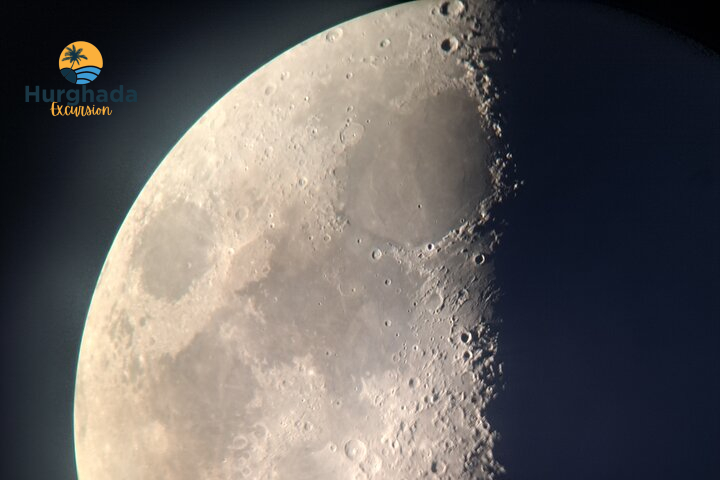
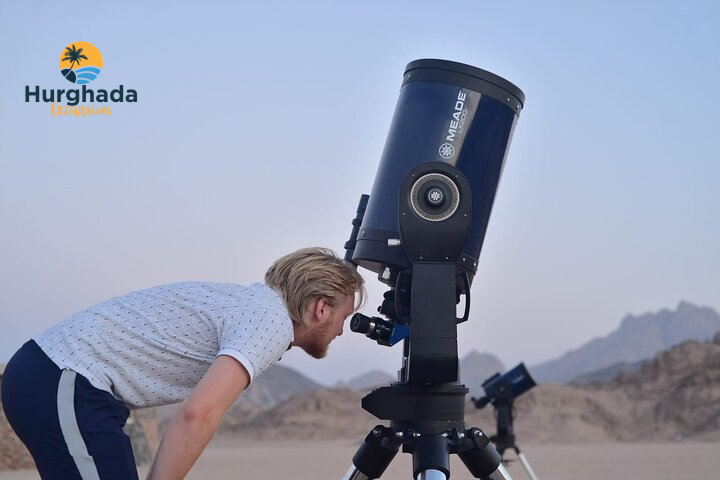
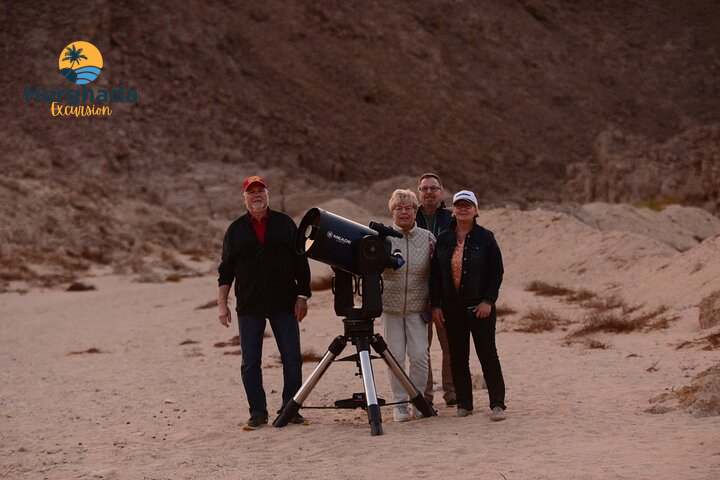
The professional astronomer guide sets up a high-powered telescope (typically a Celestron 8″ or equivalent reflector telescope) at the camp for the viewing session. Through the telescope: Saturn’s rings in sharp relief (one of the most unanimously described “life-changing moments” in the reviews), Jupiter and its four Galilean moons, the craters and maria of the Moon, the Orion Nebula (the closest stellar nursery to Earth), and a selection of deep-sky objects chosen by the astronomer based on the seasonal sky.
🌙
3. Laser Pointer Constellation Tour
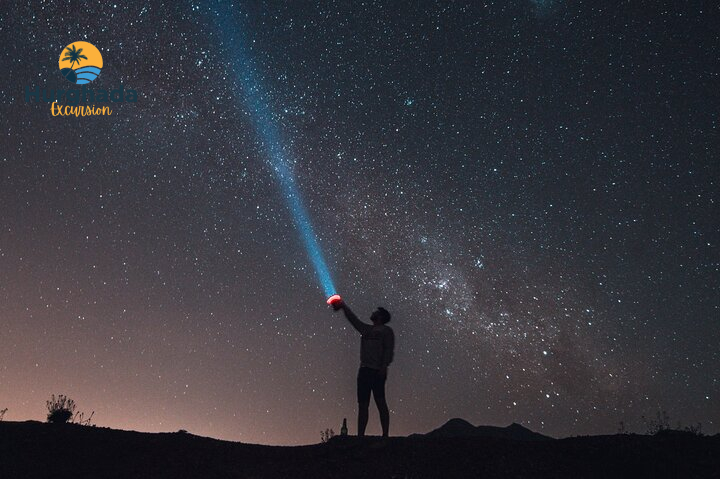
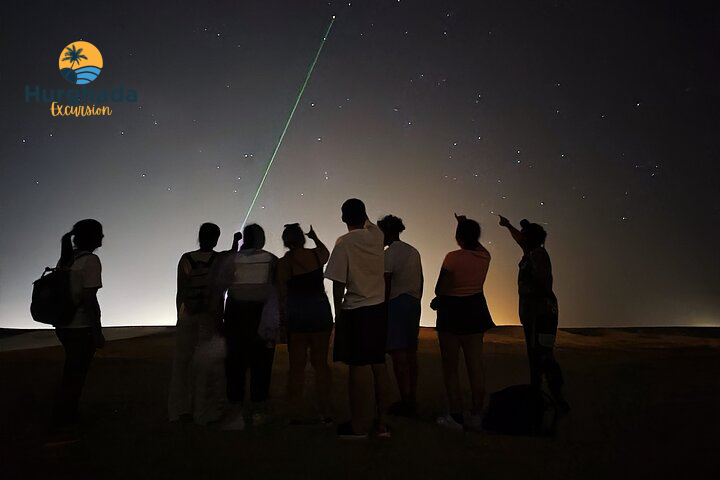
The astronomer guide uses a high-powered green laser pointer to trace the constellations visible in the current sky, delivering the complete mythology of each constellation — both the Greek/Roman tradition and, uniquely, the ancient Egyptian astronomical tradition (which was independent of the Greek tradition and assigned completely different meanings and stories to the same stars). The ancient Egyptians used the star Sirius to predict the Nile flood each year — the guide explains this extraordinary astronomical-agricultural connection while the brightest star in the sky burns overhead.
🐪
4. Sunset Camel Ride in the Desert
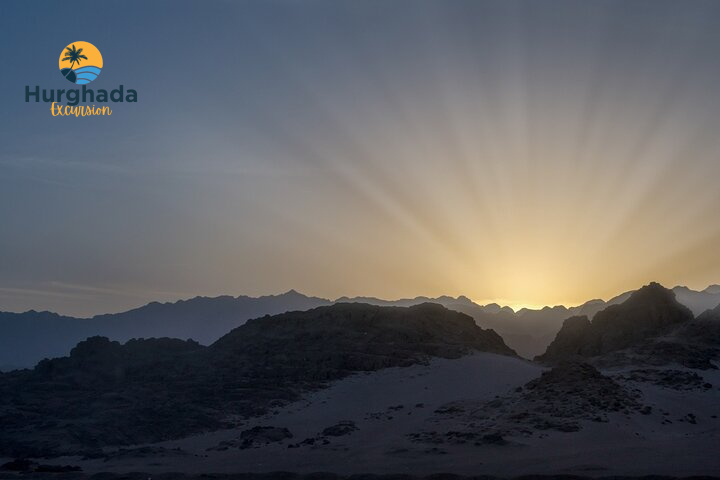
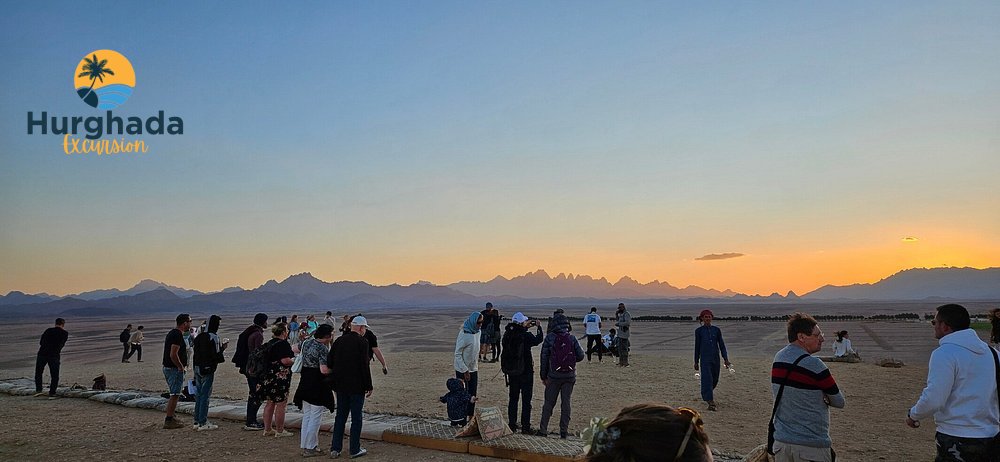
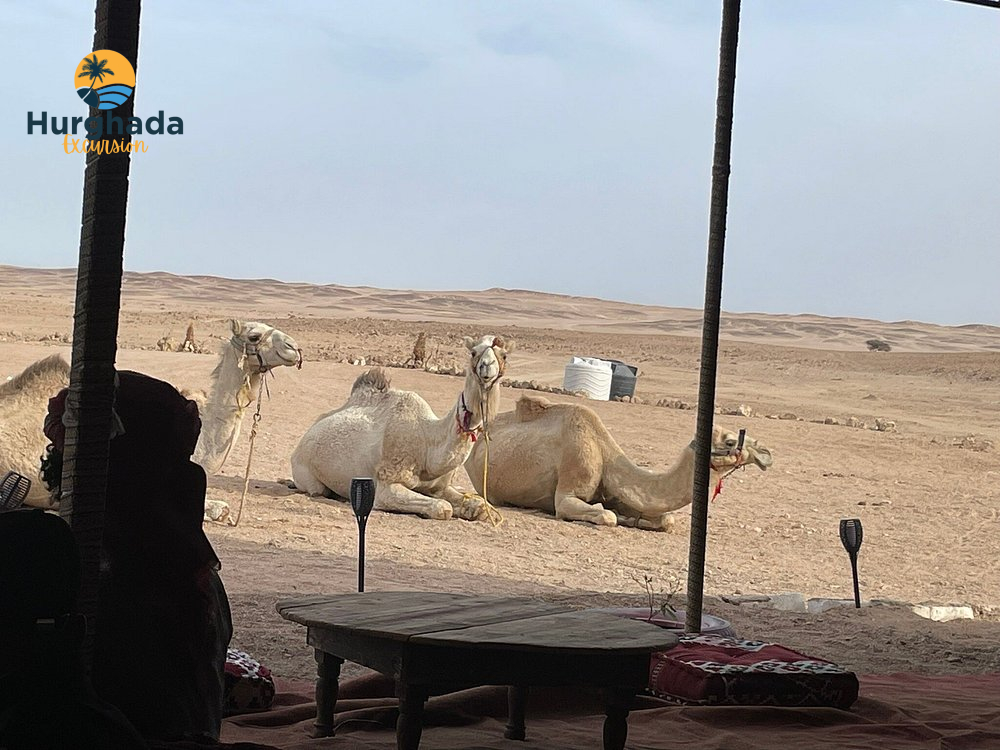
On arrival at the camp before dark, the camel ride at sunset provides the first desert experience of the evening — the sun dropping behind the mountains as the camel carries you across the orange-pink sand. The camel ride lasts 15–20 minutes, with the Bedouin handler walking alongside. The combination of the camel, the sand dunes, and the sunset light creates the most photographed moments of the entire experience — and for families with children, the camel ride is typically the most talked-about single element of the evening.
🍽️
5. Traditional Bedouin Dinner
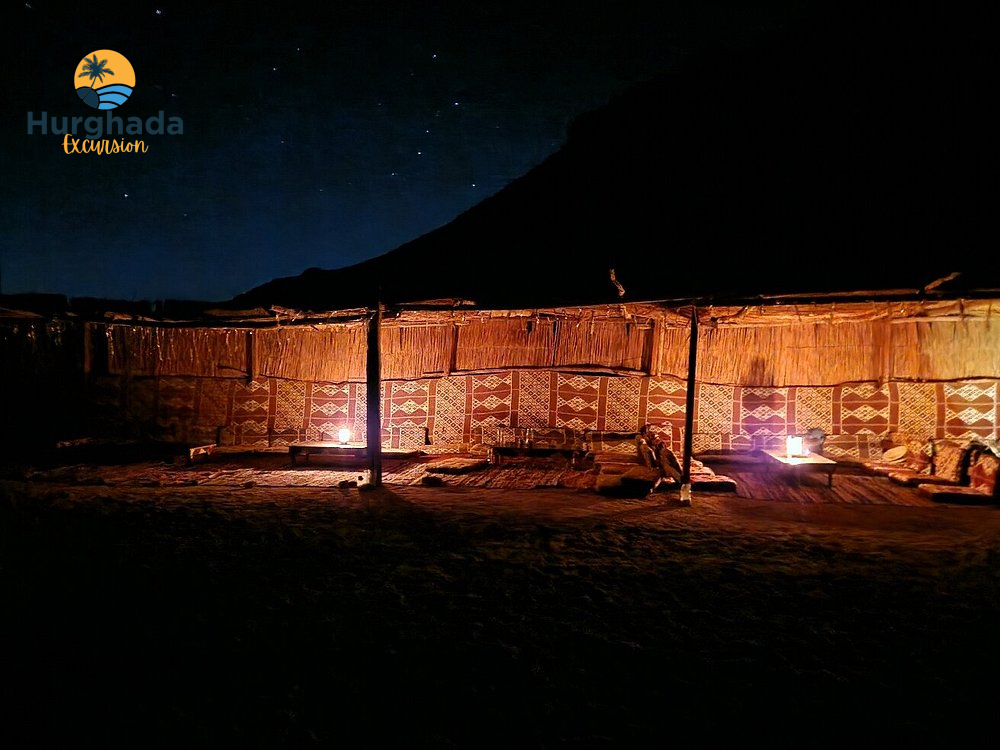
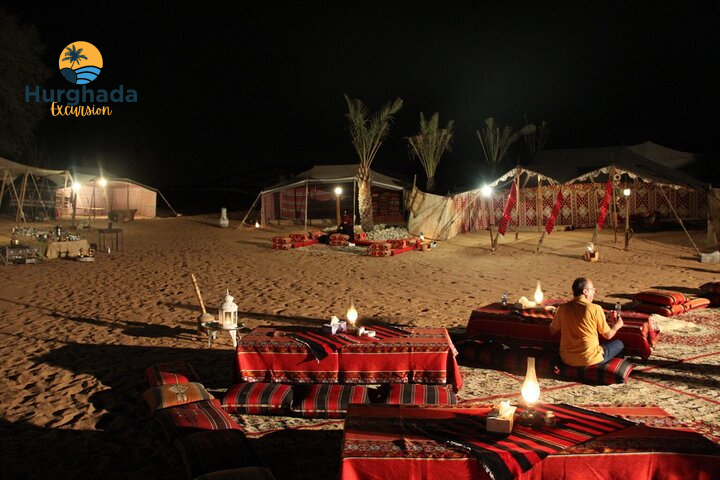
The Bedouin dinner is served under the handwoven tent at low tables on traditional cushions — a complete traditional meal of slow-cooked lamb or chicken (prepared over the wood fire), Egyptian ful medames (spiced fava beans), koshary, grilled flatbreads baked in the desert sand, fresh salads, tahini, pickles, and the honey-sweet pastries of Egyptian desert hospitality. The Bedouin tea ceremony — mint tea poured from height into small glasses — opens and closes the dinner.
🔥
6. Traditional Fire Show
After dinner, the Bedouin fire show — performed by a local dancer trained in the traditional fire performance of the Sinai and Eastern Desert Bedouin communities. The fire show typically includes fire juggling, fire breathing, and a spinning fire performance (similar to the Tanoura but with fire torches rather than coloured fabric). Set against the desert dark and the star-filled sky, the fire performer creates one of the most visually dramatic moments available on any Hurghada evening excursion.
🎵
7. Live Bedouin Music
Traditional Bedouin musicians perform on the tabla (hand drum), the simsimiyya (traditional Red Sea coastal lyre), and occasionally the oud. The music creates the atmospheric backdrop for the dinner and the fire show — the ancient rhythms of the desert, performed live by musicians whose families have lived in the Eastern Desert for generations. Guests are invited to participate in simple percussion rhythms and traditional line dances around the fire.
🏜️
8. Sandboarding & Desert Activities
Sandboarding is available at the sand dune section adjacent to the camp — a wooden board (similar to a snowboard but designed for sand) is ridden face-first down the steep side of a natural sand dune. For children and adventurous adults, the sandboarding provides the active complement to the contemplative stargazing. ATV quad bikes are also available at the adjacent dune section for guests who want a motorised desert experience before the astronomical night begins.
🌿
9. Bedouin Henna & Craft
A henna artist offers traditional Bedouin henna designs throughout the evening — typically applied to the hands and feet, the designs draw on both the traditional geometric patterns of Eastern Desert Bedouin art and the more elaborate floral patterns of Egyptian urban henna traditions. The henna service is included for guests who request it. A small selection of handmade Bedouin craft items (woven bracelets, silver jewellery, stone carvings) is available for purchase from the camp’s craft stall.
🔇
10. The Desert Silence
Between the activities and the dinner, the camp falls into the profound silence of the desert — no traffic, no air conditioning, no hotel noise. Just the faint crackle of the fire, the distant call of a night bird, and the complete absence of human sound infrastructure. For most guests from urban environments, this silence — experienced while lying on cushions under the Milky Way — is among the most genuinely affecting moments of their entire trip to Egypt. The astronomer guide builds designated “silence minutes” into the evening programme.
📸
11. Astrophotography Session
The astronomer guide provides a dedicated astrophotography session for guests with cameras or modern smartphones — explaining how to set the camera (30-second exposure, ISO 3200, f/2.8 or widest aperture available, manual focus on infinity) for Milky Way photography. The guide assists with setup and confirms focus before the shot. Most modern smartphones (iPhone 14+, Samsung Galaxy S22+) have dedicated night modes that produce excellent Milky Way images without any additional equipment.
🌡️
12. The Egyptian Night Sky — Pharaonic Astronomy
The astronomer guide delivers a complete session on ancient Egyptian astronomy — the most sophisticated astronomical tradition of the ancient world, which produced the 365-day solar calendar, used star alignments to orient the pyramids with extraordinary precision, and developed a complete cosmological system in which the night sky was the literal body of the goddess Nut arched above the earth. The ancient Egyptian star map — the Senenmut tomb ceiling — is among the oldest astronomical charts ever discovered.
Complete Evening Itinerary — Start to Finish
Here is the complete Hurghada stargazing desert experience with Bedouin dinner itinerary — every activity and transition detailed, from hotel pickup to return:
🌟 STARGAZING & BEDOUIN DINNER — COMPLETE EVENING PROGRAMME (STANDARD 4.5-HOUR)
Hotel pickup 18:00 (summer) / 16:30 (winter) · Desert drive ~40 min · Arrival at camp ~18:45 · Sunset camel ride (18:45–19:15) · Bedouin welcome tea + sandboarding/henna (19:15–20:00) · Traditional Bedouin dinner under the tent (20:00–21:00) · Fire show + live music (21:00–21:30) · Telescope stargazing + astronomer session (21:30–22:30) · Astrophotography + Milky Way time (22:30–22:45) · Return drive ~40 min · Hotel arrival ~23:30
18:00 (SUMMER) / 16:30 (WINTER) · Hotel Pickup
🚌 Hotel Pickup & Desert Briefing in Transit
Pickup from your Hurghada hotel in an air-conditioned vehicle. The pickup timing is seasonal — sunset occurs at approximately 19:30 in summer (June–September) and 17:30 in winter (December–February), and the schedule is calibrated to arrive at the desert camp approximately 30–40 minutes before sunset for maximum golden-hour desert light and the camel ride timing.
During the 40-minute desert drive, the guide delivers the evening briefing: the camp’s history and the Bedouin family who runs it, the Eastern Desert geography, the astronomical programme for the evening (which planets are visible tonight, what the astronomer will show through the telescope), and the weather forecast confirmation (desert cloud cover, wind conditions, and expected temperature at the camp — which can be 8–12°C cooler than Hurghada’s coastline in the evening).
What to bring to the stargazing desert experience: Light warm layer or jacket (the desert cools significantly after sunset — even in summer, the camp temperature can drop to 18–22°C by 22:00) · Closed shoes or trainers (desert sand at night can be cool and occasionally rough-surfaced) · Camera or smartphone with night mode · Insect repellent (optional — the desert has minimal insect activity but personal preference) · Any personal medications · EGP cash for optional henna, crafts, or ATV rides. Everything else — dinner, tea, equipment, blankets for stargazing — is provided at the camp.
18:45 – 19:15 · Camp Arrival & Sunset Camel Ride
🐪 Desert Camp Arrival — First Bedouin Tea & Camel Ride at Sunset
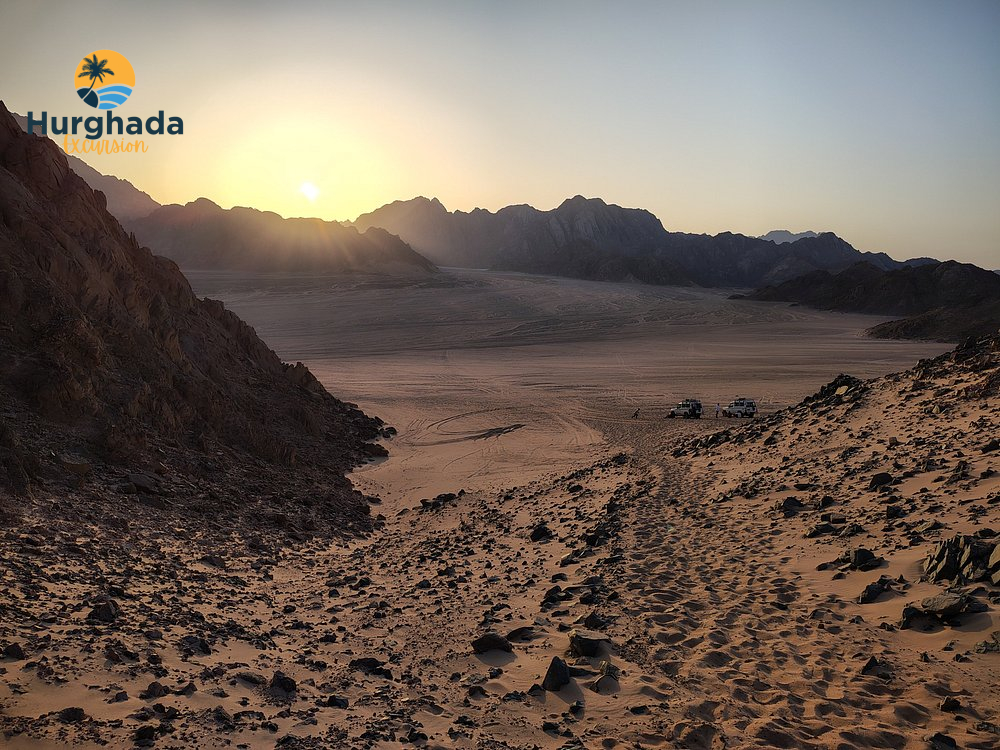
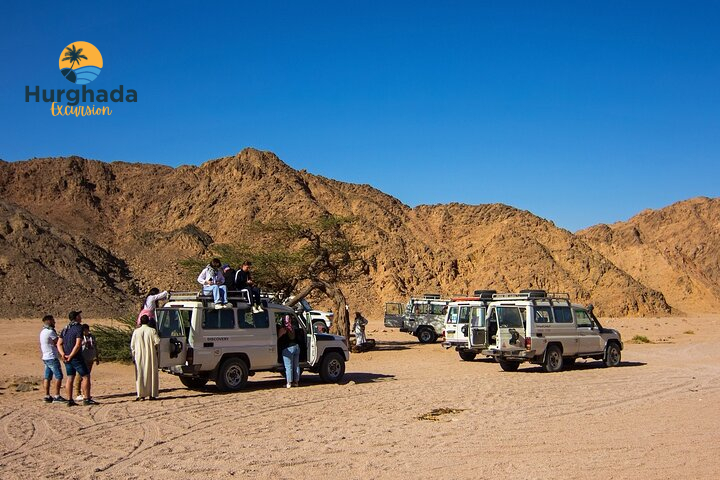
Arrival at the Bedouin desert camp — approximately 30 km west of Hurghada in the Eastern Desert, at a site selected specifically for its combination of dark sky (minimal horizon light pollution), natural sand dunes for activities, and the traditional flat desert terrain that provides 360° sky visibility for astronomical observation. The camp consists of a handwoven Bedouin tent (the main dining and entertainment space), a fire pit area, a telescope platform (a flat rock or concrete pad oriented for unobstructed north sky access), and the camel paddock area at the dune edge.
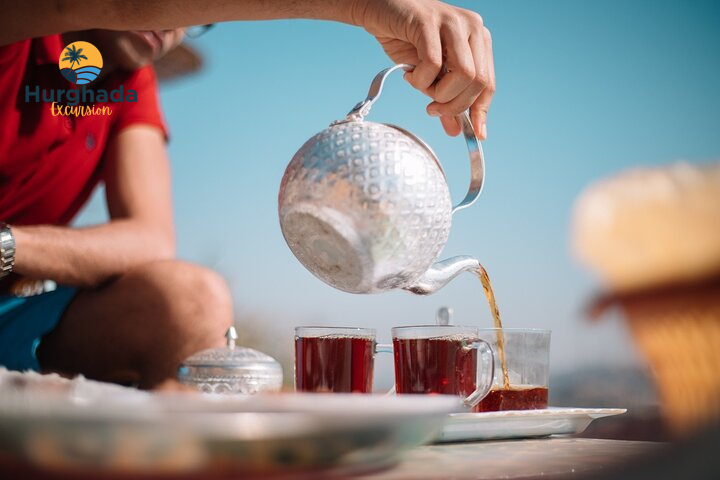
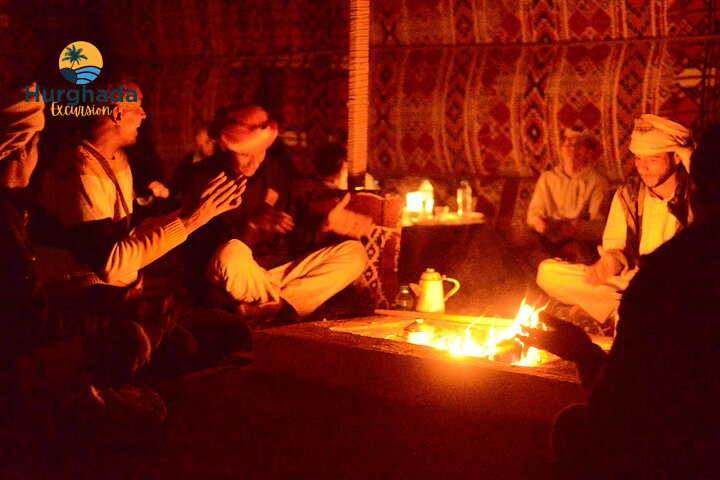
The Bedouin host welcomes each guest with the traditional welcome tea — sweet mint tea poured from a height with characteristic frothing, served in small glass cups. This ceremony is the formal Bedouin greeting ritual — accepting the tea is accepting the host’s hospitality and protection. The guide explains the tradition and its significance in Bedouin culture.
The sunset camel ride begins immediately after the welcome tea — the sun is still above the western horizon, casting long golden shadows across the desert sand. The Bedouin handler leads each guest’s camel in a 15–20 minute circuit of the dune area, returning to the camp as the last colour fades from the sky. The guide and camp photographer take photographs and video during the camel ride from the best positions.
19:15 – 20:00 · Free Activity Period
🏜️ Sandboarding · Henna · Desert Exploration · Photography
The dusk activity period — the sky transitioning from deep orange to purple to the first stars appearing. During this period, guests can choose their activities freely: sandboarding on the adjacent dune (guide supervises — boards provided, instruction given), henna with the camp’s henna artist (seated under the tent, 15-minute session), exploring the immediate desert environment with the guide (fossil identification, sand formation explanation), or simply sitting with tea watching the sky darken and the stars appear one by one.
The astronomer guide uses this period to set up the telescope and calibrate it for the night — aligning to a reference star and confirming the evening’s observation targets. The first stars visible (typically Venus or Jupiter appearing while the sky is still twilight blue) provide the first observation opportunity — the astronomer explains why bright planets are visible before stars and invites early telescope views for eager observers.
20:00 – 21:00 · Traditional Bedouin Dinner
🍽️ Dinner Under the Stars — Bedouin Fire-Cooked Feast
The traditional Bedouin dinner — served at low cushion-seated tables inside and outside the tent, with the fire glowing at the centre of the camp and the Milky Way now beginning to emerge overhead. The meal is prepared by the Bedouin cook using wood fire and traditional methods:
🥗 Starters & Mezze
Hummus · tahini · babaganoush · ful medames · fresh tomato and cucumber salad · pickled vegetables · olives · baladi flatbread baked in the desert sand (the most authentic detail of the entire dinner — the dough is placed directly on the hot sand surface and covered with embers)
🍖 Main Course
Slow-cooked lamb with spices OR grilled chicken (farrakh mashwi) OR vegetarian option: koshary (Egypt’s national dish — rice, lentils, pasta, crispy onions, tomato sauce) · all cooked over the open fire · served with rice and grilled vegetables
🍯 Dessert & Tea
Om Ali (Egyptian bread pudding with cream and nuts) · fresh fruit · basbousa (semolina honey cake) · Egyptian tea with mint or sage · second Bedouin tea ceremony marking the end of the meal
Dietary requirements (vegetarian, vegan, gluten-free) are accommodated — confirm at booking. The guide ensures the cook is briefed on any specific dietary needs before the evening begins.
21:00 – 21:30 · Fire Show & Live Music
🔥 Traditional Bedouin Fire Show & Desert Music
After dinner, the Bedouin fire show begins — the fire performer takes the camp stage (the open area in front of the tent) with lit torches. The performance lasts 15–20 minutes and includes spinning fire, figure-eight patterns, and the theatrical fire-breathing finale. The backdrop of the dark desert sky with the Milky Way above and the fire performer below creates one of the most visually spectacular moments of any Hurghada evening excursion.
The live Bedouin music session follows or accompanies the fire show — tabla, simsimiyya, and vocal performance. Guests are invited to join the circle around the fire for traditional hand-clapping rhythm participation and simple line dancing. The guide explains the musical traditions and the specific songs performed (many are love songs, travel songs, and descriptions of desert landscapes that have been passed orally for centuries).
21:30 – 22:30 · THE MAIN EVENT — Telescope Stargazing Session
🌟 Professional Stargazing — Telescope, Constellations & Planets
The centrepiece of the evening — the professional stargazing session, led by the astronomer guide at the telescope platform. The fire is dimmed (to protect night vision — any bright light source takes 20–30 minutes to recover from), and the group moves to the telescope area where blankets and cushions are available for lying on the desert floor for the naked-eye observation section.
Phase 1 — Naked-Eye Sky Tour (20 minutes): The astronomer uses the green laser pointer to identify the major constellations visible tonight — beginning with the most recognisable (Orion in winter, Scorpius in summer) and progressing to the fainter, less-known constellations. Each constellation receives its Greek mythology, its Arabic name (Arab astronomers preserved and extended Greek astronomical knowledge during the medieval period — many of the star names used today are Arabic), and its Egyptian mythological counterpart. The Milky Way itself is identified and its structure explained — the view in the dark desert reveals the galactic centre, the dust lanes, and the concentration of stars near Sagittarius that indicates the galaxy’s core.
Phase 2 — Telescope Observation (40 minutes): Each guest takes turns at the telescope eyepiece for the prepared sequence of objects: Saturn with rings (the universal reaction is silence followed by “is that real?” — the rings visible with sharp clarity), Jupiter with Galilean moons (Io, Europa, Ganymede, Callisto — the astronomer identifies each moon by position), the Moon (crater details, mountain ranges, the mare — the dark volcanic plains that the ancient Egyptians associated with the eye of Horus), and selected deep-sky objects: the Orion Nebula (M42 — the closest stellar nursery, glowing with the light of forming stars 1,300 light-years away), the Pleiades cluster, and any other notable objects appropriate to the current season.
Phase 3 — Ancient Egyptian Astronomy (10 minutes): Seated under the Milky Way, the astronomer delivers the Pharaonic astronomy narrative — the role of Sirius (the star Sopdet) in timing the Nile flood, the astronomical precision of the Giza pyramid alignment (the Great Pyramid’s north face is aligned to true north with an accuracy of 0.05 degrees — achieved without modern instruments 4,500 years ago), and the complete cosmological system in which the star-field visible above is the literal body of the sky goddess Nut.
22:30 – 22:45 · Astrophotography & Final Desert Moment
📸 Astrophotography Session & Desert Farewell
The astronomer guide assists each guest individually with their Milky Way photography setup — confirming camera settings, helping with focus, and timing the exposure during the period of maximum sky clarity. A 30-second exposure on a modern DSLR or mirrorless camera (f/2.8, ISO 3200, manual focus on infinity) produces an extraordinary photograph. The astronomer then takes a group photo with the Milky Way above and the camp fire below — available as a digital download from the guide’s phone immediately after the session. Final farewell tea is served as the group prepares to return.
22:45 – 23:30 · Return Drive to Hurghada
🚌 Return Through the Dark Desert · Hotel Dropoff
The return drive to Hurghada — the desert is completely dark during the 40-minute transit, and the stars are still visible through the vehicle windows. The guide is available for astronomy questions during the return drive. Hotel dropoff at approximately 23:30 (summer) / 22:00 (winter). The guide shares the group’s photographs via WhatsApp before reaching the hotel.
The Stargazing Session — Telescope, Constellations & Planets
Seasonal Sky Guide
What You See by Season
Winter (Nov–Feb): Orion with the Orion Nebula · the Pleiades cluster · Sirius (brightest star in the sky) · the Winter Hexagon · Jupiter in the evening sky (most years) · Milky Way visible as a winter band. Summer (May–Sep): The Milky Way core (Sagittarius/Scorpius — the brightest and most dramatic section) · the Summer Triangle (Vega, Deneb, Altair) · Saturn typically at opposition (closest to Earth) · the Scorpius constellation visible in full. Saturn’s rings visible year-round when Saturn is above the horizon.
The Equipment
The Telescope — Celestron 8″ Reflector
The standard telescope used for the Hurghada stargazing experience is a Celestron C8 (8-inch aperture Schmidt-Cassegrain reflector) or equivalent — a professional-grade instrument that is among the finest portable astronomical telescopes available. At 200x magnification, Saturn’s rings are visible with the Cassini Division clearly separated; at 100x, Jupiter’s four Galilean moons are individually resolved. The astronomer guide also carries a pair of 10×50 binoculars for wider-field views of the Milky Way and open star clusters.
Ancient Connection
The Pyramids Were Built by This Sky
The astronomer’s most powerful narrative — standing in the desert under the same sky the pyramid architects used: the Great Pyramid of Giza is aligned to within 0.05° of true north using stellar observations of the north celestial pole. The air shaft in the King’s Chamber was aligned to the star Thuban (then the north pole star) at the moment of construction. The three Giza pyramids may correspond to the three belt stars of Orion (Sah in Egyptian) — a cosmological map on the desert ground of the heavenly configuration overhead.
Bedouin Culture & Desert Heritage
🏜️ Who Are the Bedouin of Egypt’s Eastern Desert?
The Bedouin (from the Arabic badawi — “desert dweller”) of Egypt’s Eastern Desert are primarily the Ma’aza tribe — one of the oldest and most distinguished of Egypt’s desert peoples, with a documented history in the Eastern Desert stretching back 2,000+ years. The Ma’aza traditionally guided trade caravans between the Nile Valley and the Red Sea ports, providing knowledge of water sources, pasture, and safe passage through terrain that was lethal to the uninitiated.
The Bedouin hospitality tradition — the foundation of all desert social interaction — is one of the most deeply felt ethical systems in Arabic culture. The desert environment, where survival depends on mutual assistance between travellers, produced a code of hospitality so stringent that a guest, once offered tea, was under the host’s full protection for three days and three nights. This tradition is the cultural context of the Bedouin welcome tea ceremony that opens the evening.
The Bedouin camp that hosts the Hurghada stargazing experience is operated by a family that has lived in the Eastern Desert for generations — the camp host’s father guided survey expeditions in the 1970s and 1980s, and his children now manage the tourism operation that brings the desert hospitality tradition to international visitors. The family also maintains a small herd of camels that are used for the sunset rides.
The Bedouin Dinner — Traditional Menu & Fire Cooking
🥖
Sand-Baked Bread — Aish Beldi
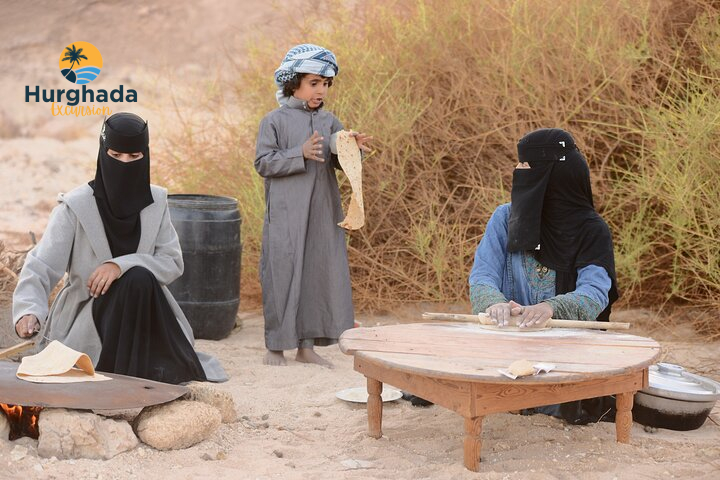
The most distinctively authentic element of the Bedouin dinner — flatbread dough placed directly on the hot desert sand and covered with glowing embers from the fire. The bread bakes from below (the hot sand, which retains and radiates heat like an oven floor) and above (the embers), producing a charred exterior with a soft, chewy interior that is nothing like any bread baked in a conventional oven. The cook brushes off the sand and cuts the bread into pieces for the table while still warm from the desert floor.
🫖
The Bedouin Tea Ceremony
Bedouin tea (shai) is prepared in a specific way — black tea with fresh mint, sugar, and sometimes desert sage (ma’ramiyya), boiled in a traditional small kettle over the fire, then poured into small glasses from a height of 30–40 cm to create characteristic froth. The pouring from height is not theatrical — it aerates the tea to improve flavour. Three glasses of tea are traditionally served in sequence: the first bitter (representing life), the second sweet (representing love), the third gentle (representing death — meaning the final peaceful rest).
All Desert Activities — Complete Activity Guide
| Activity |
Duration |
Included |
Min. Age |
| Sunset camel ride |
15–20 min |
✓ Yes |
3+ (shared with adult) |
| Sandboarding |
30 min available |
✓ Yes |
6+ |
| Bedouin dinner |
60 min |
✓ Yes |
All ages |
| Fire show performance |
15–20 min |
✓ Yes |
All ages (supervised) |
| Live Bedouin music |
30–40 min |
✓ Yes |
All ages |
| Telescope stargazing |
60 min |
✓ Yes |
All ages |
| Henna application |
15 min |
✓ Yes (one design) |
5+ |
| Astrophotography session |
15 min |
✓ Yes (guide assistance) |
All ages |
| ATV quad bike (dunes) |
15–30 min options |
Optional — extra cost |
16+ (solo) · 6+ (with adult) |
Included & Not Included — Full Breakdown
✓ Hotel pickup & return transfer from Hurghada hotels
✓ Traditional Bedouin dinner (full meal with mezze, main course, dessert)
✓ Unlimited Bedouin tea & soft drinks throughout
✓ Sunset camel ride (15–20 min per person)
✓ Professional telescope stargazing (60 min astronomer-led)
✓ Constellation tour with laser pointer + ancient Egyptian astronomy
✓ Fire show performance + live Bedouin music
✓ Sandboarding at the dunes
✓ Henna (one design per guest)
✓ Astrophotography assistance + group Milky Way photo
✓ Desert blankets & cushions · free cancellation 48h before
✗ Alcoholic beverages (the Bedouin camp is alcohol-free)
✗ ATV/quad bike rides (available on site — extra cost, approximately 150–200 EGP)
✗ Tips for guides, Bedouin hosts, musicians (customary — appreciated)
✗ Handmade crafts and jewellery at the camp souvenir stall
✗ Personal travel insurance
✗ Camera equipment (bring your own phone or camera)
✗ Additional henna designs beyond the included one (extra cost)
📋 Tour Quick Reference
| Detail |
Standard Tour |
Private VIP Tour |
| Duration |
4–4.5 hours total |
5–6 hours (fully flexible) |
| Pickup Time (Summer) |
18:00 PM |
17:30–18:30 (your choice) |
| Pickup Time (Winter) |
16:30 PM |
15:30–17:00 (your choice) |
| Return to Hotel |
~22:30–23:30 |
Flexible — your request |
| Languages |
English · Arabic |
+ German · French · Russian · Italian (48h notice) |
| Group Size |
2–30 (shared group) |
2–15 (private camp) |
Best Season & Monthly Sky Guide
| Month |
Highlights in Sky |
Camp Temp |
Verdict |
| Jan – Feb |
Orion · Sirius · Pleiades · Winter Hexagon |
12–18°C at night |
Excellent — bring warm jacket |
| Mar – May |
Leo · Virgo · Jupiter rising · Spring Milky Way |
18–24°C at night |
Ideal — comfortable & spectacular |
| Jun – Aug |
Milky Way core · Saturn at opposition · Scorpius |
24–28°C at night |
Peak for Milky Way · Saturn viewing |
| Sep – Oct |
Milky Way setting · Summer Triangle · Pegasus |
20–25°C at night |
Very good — transition season |
| Nov – Dec |
Orion returning · Taurids meteor shower (Nov) · Geminids (Dec 13) |
14–20°C at night |
Excellent · meteor shower events |
Stargazing Experience Price 2026 — All Options
Hurghada Stargazing Desert Bedouin Dinner — From
€35
per adult · Shared group · All-inclusive: dinner, camel, stargazing, fire show, music
✓ Hotel pickup · ✓ Dinner · ✓ Telescope · ✓ Fire show · ✓ Camel · ✓ All activities
Children 4–11: 50% discount · Under 4: free · Private VIP camp: from €200/group (2–15 guests)
| Option |
Price |
Group Size |
Includes |
| Standard Shared Tour |
€35/adult · €18/child |
Up to 30 guests |
All standard programme · shared guide |
| Private VIP Group (2–8 guests) |
€200/group total |
2–8 guests |
Private camp · dedicated astronomer · flexible schedule |
| Private VIP (8–15 guests) |
€280/group total |
8–15 guests |
Full private programme + extra telescope |
| Honeymoon/Special Occasion Upgrade |
+€50 above private price |
2 guests |
Private tent · rose petals · cake · personalised star certificate |
Combine with Other Excursions — Internal Linking
The Hurghada stargazing experience departs in the evening — making it the perfect complement to any morning day trip. Here are the best combinations for a complete Egypt itinerary:
🌊 Hurghada → Red Sea Excursions (Morning + Evening Combinations):
07:00–14:00 · Wild dolphins + reef
🌟 Evening: Stargazing + Bedouin Dinner
18:00–23:00 · Desert + Milky Way
05:30–18:30 · Sea turtles + Marsa Alam
🌟 Same Evening: Stargazing
The contrast: Red Sea morning → Desert stars evening
09:00–13:00 · Eastern Desert daytime
🌟 Evening: Same desert by night
Experience the Eastern Desert in full day and night contrast
🗺️ Hurghada → Marsa Alam → El Quseir (Southern Red Sea Route — 3 Day Itinerary):
📍 Day 1 — Hurghada
Evening: Stargazing & Bedouin Dinner ← You Are Here
📍 Day 2 — Sharm El Naga
Near Soma Bay · hawksbill turtles · lionfish
📍 Day 3 — Abu Dabbab + Marsa Alam
Return via El Quseir old port town
🏺 Hurghada → Luxor → Cairo → Abu Simbel (Complete Egypt Cultural Route):
🌟 Hurghada Nights
Stargazing Bedouin dinner · Red Sea marine excursions
10 Expert Tips for the Best Stargazing Experience
Tip 1 — Book on a new moon night for the finest stargazing — the moonlight significantly reduces visible star count. The lunar phase is the most important variable in dark-sky astronomy. A full moon illuminates the night sky brightly enough to reduce the number of visible stars by 90% and make the Milky Way invisible. The best stargazing nights are within 5 days of the new moon — when the sky is completely moonless. Check the lunar calendar before booking and request a new-moon night. The guide can advise on optimal upcoming dates. Our booking system tracks lunar phases and recommends dates automatically.
Tip 2 — Bring a warm jacket — the desert at night is significantly cooler than the Hurghada coastline. The Eastern Desert temperature drops rapidly after sunset — the desert has no water vapour or coastal thermal mass to retain daytime heat. In summer, the evening temperature at the camp can be 18–22°C by 22:00 (compared to 30°C+ in Hurghada). In winter, temperatures at the camp can drop to 10–14°C by midnight. Blankets are provided on site, but a personal jacket ensures maximum comfort during the outdoor stargazing session.
Tip 3 — Allow your eyes 20–30 minutes to fully dark-adapt before the telescope session. The human eye takes 20–30 minutes to achieve full dark adaptation after exposure to bright light — during this time, the rod cells in the retina achieve maximum sensitivity to low light. Looking at a bright phone screen during the dark-adaptation period destroys it instantly. The astronomer guide will ask guests to avoid phone screens (except in night mode with red filter) during the observation period. The dinner and fire show provide the dark-adaptation window before the telescope session begins.
Tip 4 — Accept the camel ride — it is the most culturally authentic element of the evening. Many guests hesitate at the camel ride, thinking it is a tourist cliché. It is not — riding a camel through the Eastern Desert at sunset, with the mountains turning red behind you and the first stars beginning to appear, is a genuinely extraordinary physical experience. The camel’s characteristic rolling walk, the elevation above the ground (providing a panoramic desert view impossible from the sand), and the cultural authenticity of the moment (camels have been used in this desert for 3,000 years) combine to make the sunset camel ride one of the most distinctive moments of the evening.
Tip 5 — Eat the sand-baked bread first — it is the most authentic food experience of the evening. The traditional Bedouin sand-baked flatbread (aish fi raml) is the most distinctive culinary element of the dinner and should be tried immediately — the bread is at its finest warm from the desert floor, and its texture and flavour are genuinely unlike anything available in a conventional kitchen. Ask the cook to explain the preparation while the bread is baking — the technique is simple but ingenious, and understanding the method makes the eating more satisfying.
Tip 6 — For astrophotography — use your phone’s dedicated night mode, not a manual camera app. Modern smartphones (iPhone 14+, Samsung Galaxy S22+, Google Pixel 6+) have built-in astrophotography modes that automatically choose the optimal settings and stack multiple exposures to reduce noise. These modes produce excellent Milky Way images that a manually-configured camera can struggle to match without considerable practice. The astronomer guide can demonstrate the smartphone night mode setup for the specific model you have. A small portable tripod (available from Amazon for €15–20) is the single most useful additional item for smartphone astrophotography.
Tip 7 — The Saturn moment is the most universally described “life-changing” experience of the tour — describe your expectations to the astronomer. When first-time telescope viewers put their eye to the eyepiece and see Saturn with its rings sharply resolved in the black sky, the reaction is almost invariably silence, then “Is that real? Is that a photograph?” The astronomer guide describes this reaction frequently — it is the single moment that guests most consistently cite as the most memorable of their Hurghada holiday. Communicating to the astronomer that you have never seen Saturn through a telescope before ensures they maximise the impact of that first view.
Tip 8 — Take your shoes off and lie directly on the desert sand during the naked-eye sky tour. The optimal position for naked-eye stargazing is lying flat on your back with the sky filling your entire field of vision — not sitting in a chair looking upward. The warm desert sand (which retains daytime heat until well into the evening) is more comfortable than it appears and provides a completely stable, naturally contoured viewing surface. The sensation of lying directly on the desert floor under the complete Milky Way — the sand beneath you, the entire Milky Way galaxy arching overhead — is one of the most profound physical experiences of the evening.
Tip 9 — Ask the astronomer about the ancient Egyptian connection to the star directly above you. The astronomer guide is trained in ancient Egyptian as well as modern astronomy — every major star visible overhead has an ancient Egyptian name and a mythological role. Sirius (the brightest star in the sky) is the most important — the ancient Egyptians called it Sopdet (the goddess who announced the Nile flood), and the heliacal rising of Sirius (its first appearance on the eastern horizon before dawn after 70 days of absence) marked the beginning of the Egyptian New Year. This star — blazing white overhead in the summer sky — is the same star that every ancient Egyptian looked for to know the flood was coming.
Tip 10 — The desert silence between activities is the most undervalued part of the evening — do not fill it with conversation. The astronomer guide builds several short designated silence periods into the programme. During these periods — typically 3–5 minutes of complete quiet, sitting around the dimmed fire under the Milky Way — the complete desert silence becomes audible for the first time. For most guests from European and North American cities, genuine silence — the absence of all human-generated sound — is an almost unknown experience. The astronomer simply says “Listen” and waits. What guests hear first is their own breathing, then their heartbeat, then the very slight sound of the desert wind. This experience of silence, described consistently in reviews as the most unexpectedly powerful moment of the evening, requires no special preparation — only the willingness to stop talking for five minutes under the most beautiful sky most guests have ever seen.
Real Reviews from Travellers
★★★★★
“The moment I put my eye to the telescope and saw Saturn — I started crying. Actual tears. I am a 47-year-old engineer who cries at almost nothing. The rings were sharp, clear, beautiful — unmistakable. The astronomer let me look for a full five minutes without moving the telescope. After that, everything else — the fire show, the extraordinary dinner, the Bedouin music, the camel at sunset — was the framing for that one moment. The most profound experience of my adult life.”
James K. (engineer) — Edinburgh · August 2025
★★★★★
“We did this on our last night in Hurghada. Biggest mistake of the trip — we should have done it first. The sand-baked bread, the camel at sunset, the fire show, the astronomer explaining Egyptian astronomy while the Milky Way arc filled the whole sky above him — we could not have imagined this experience before we had it. Booking is instant on WhatsApp. The guide was extraordinary — the best guide of our entire Egypt trip.”
Caroline & Michael T. — London · October 2025
★★★★★
“We brought our 8-year-old daughter and 11-year-old son. The guide gave each child a star chart and a torch with a red filter and made them Junior Astronomers for the evening. They competed to identify constellations. When the astronomer found the Orion Nebula through the telescope and explained it was a cloud of gas where new stars are being born right now — our son said ‘So there are baby stars being born tonight?’ and the astronomer said ‘Yes, exactly tonight.’ He still talks about it every week.”
Sarah R. (family of 4) — Manchester · March 2026
Frequently Asked Questions — Stargazing Desert Bedouin Dinner
What is the Hurghada stargazing desert experience?
The Hurghada stargazing desert experience is a 4–5 hour evening excursion to a traditional Bedouin camp in the Eastern Desert, approximately 30 km west of Hurghada. The experience combines: sunset camel ride, sandboarding, traditional Bedouin dinner with sand-baked bread and fire-cooked meat, live Bedouin music, a professional fire show, and a 60-minute professional telescope stargazing session with an astronomer guide covering constellations, planets (Saturn, Jupiter), and ancient Egyptian astronomy. The Eastern Desert has Bortle Class 2–3 sky darkness — equivalent to premier observatory sites worldwide.
What is the price of the Hurghada stargazing Bedouin dinner experience?
Hurghada stargazing desert experience price 2026: Shared group tour: €35 per adult (€18 per child 4–11, children under 4 free). Includes hotel pickup, full Bedouin dinner, all activities (camel ride, sandboarding, henna, fire show, music), and 60-minute professional telescope stargazing. Private VIP group (2–8 guests): from €200 per group. Honeymoon/special occasion upgrade: +€50. Free cancellation 48 hours before.
When is the best time to visit for stargazing in Hurghada?
The best stargazing is available year-round from the Eastern Desert (300+ clear nights/year). For Milky Way core visibility: June–September (best). For Saturn at its closest: varies by year — typically July–September. For Orion and winter constellations: November–February. Most important factor: book on a new-moon night — within 5 days of new moon, the sky is completely moonless and star visibility is maximum. A full moon reduces visible stars by 90% and makes the Milky Way invisible.
Is the experience suitable for children?
Yes — the Hurghada stargazing Bedouin dinner experience is highly suitable for children of all ages. The camel ride is available for children aged 3+ (shared with a parent for younger children). Sandboarding is suitable for children 6+. The telescope stargazing is available for all ages — children typically respond to the Saturn view even more intensely than adults. The astronomer guide provides child-adapted commentary (including “baby stars being born tonight” explanations for the Orion Nebula). Children’s star chart activity packs and red-filter torches are available. The dinner includes child-appropriate dishes.
What languages is the stargazing tour available in?
The standard tour is conducted in English and Arabic. With 48 hours’ advance notice, specialist guides are available in German, French, Russian, and Italian. The astronomy terminology used in the session is explained in simple language regardless of the tour language — the constellations and planets are identified in both the English/Latin tradition and the Arabic tradition (many star names — including Aldebaran, Betelgeuse, Rigel, Deneb, and Altair — are directly from Arabic, as Arab astronomers preserved and advanced Greek astronomical knowledge in the medieval period).
Book Your Hurghada Stargazing Desert Experience
From €35 per adult · Hotel pickup · Bedouin dinner · Camel ride · Fire show · Professional telescope · Saturn’s rings · Milky Way · Ancient Egyptian astronomy · Free Cancellation 48 Hours Before.
🌟 Book Now — From €35 per Adult
The Hurghada stargazing desert experience with Bedouin dinner provides the one thing that no hotel, no beach, no reef, and no monument can provide — the absolute silence of the Egyptian desert at night, the Milky Way arching overhead from horizon to horizon, and the realisation that the same sky that guided the builders of the pyramids 4,500 years ago is still there, unchanged, legible, and extraordinary. The astronomer’s Saturn view — that moment when the rings appear in the eyepiece for the first time — is described by guests as one of the most memorable moments of their lives, not because it is the most dramatic experience available, but because it is the most genuinely unexpected. You expected a nice evening in the desert. You did not expect to cry at the sight of a planet 1.4 billion kilometres away.
Book your Hurghada stargazing desert experience today — professional astronomer guide, traditional Bedouin hospitality, and the most beautiful sky available from the Red Sea coast.
🔗 More Hurghada & Egypt Excursions: