🐎 Desert Horse Riding · Great Pyramids · Giza Plateau · Sunrise & Sunset · From Hurghada
Giza Plateau Horse Riding – Desert Ride with Pyramids Background
📅 Updated: May 2026 | ⏱️ 1–3 Hours · Full Day from Hurghada | 💶 From €25 / person (in Giza) | ⭐ 4.8/5 Rated | 🐎 Daily Departures
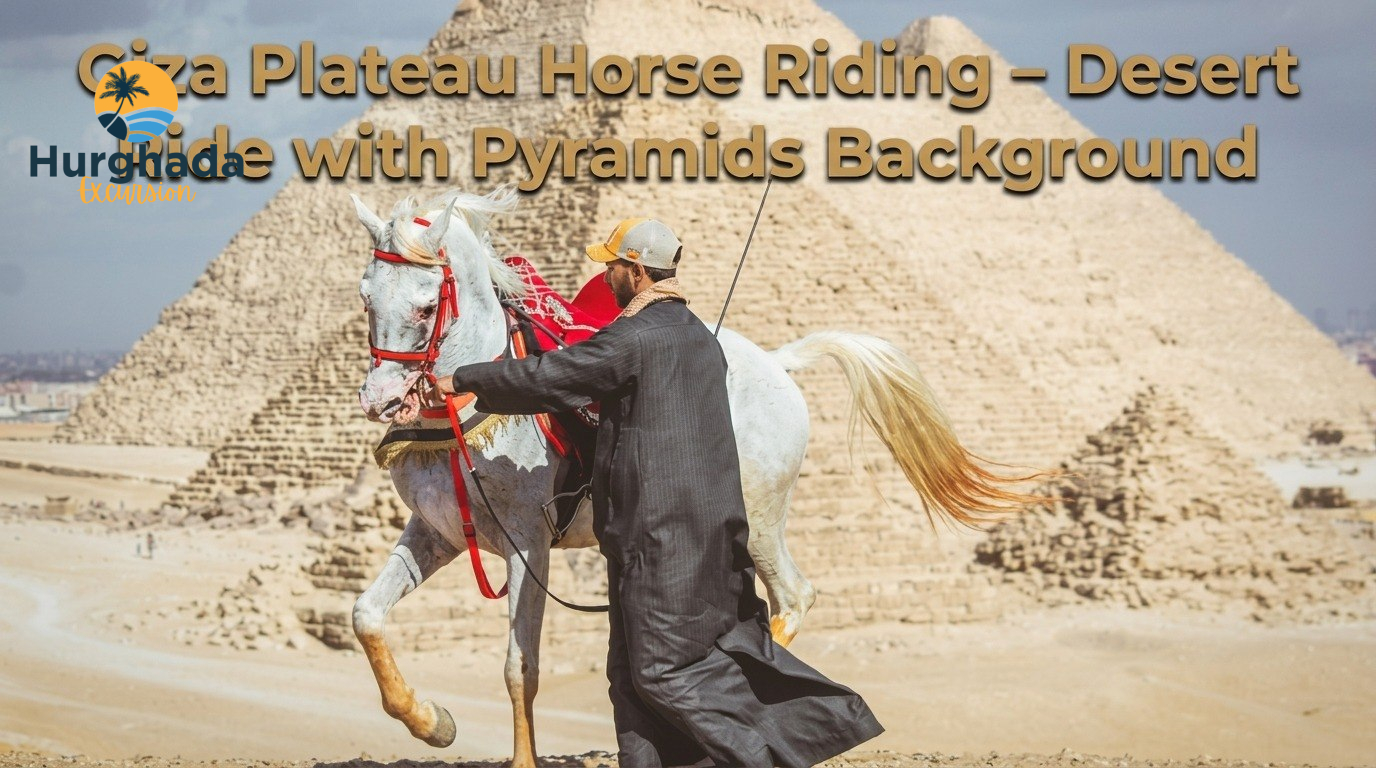
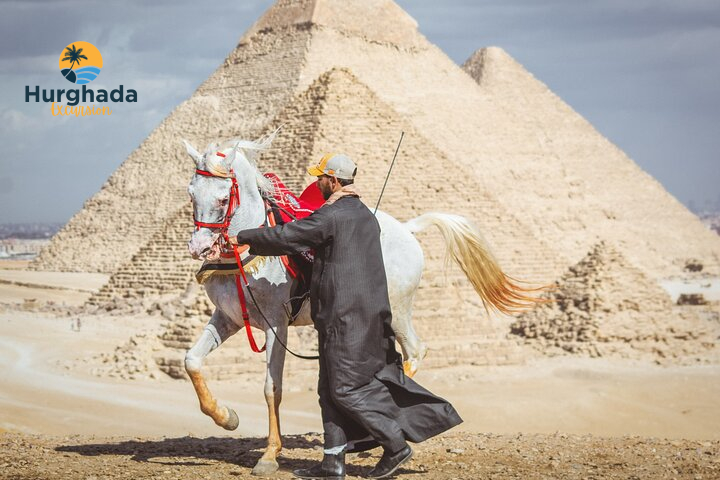
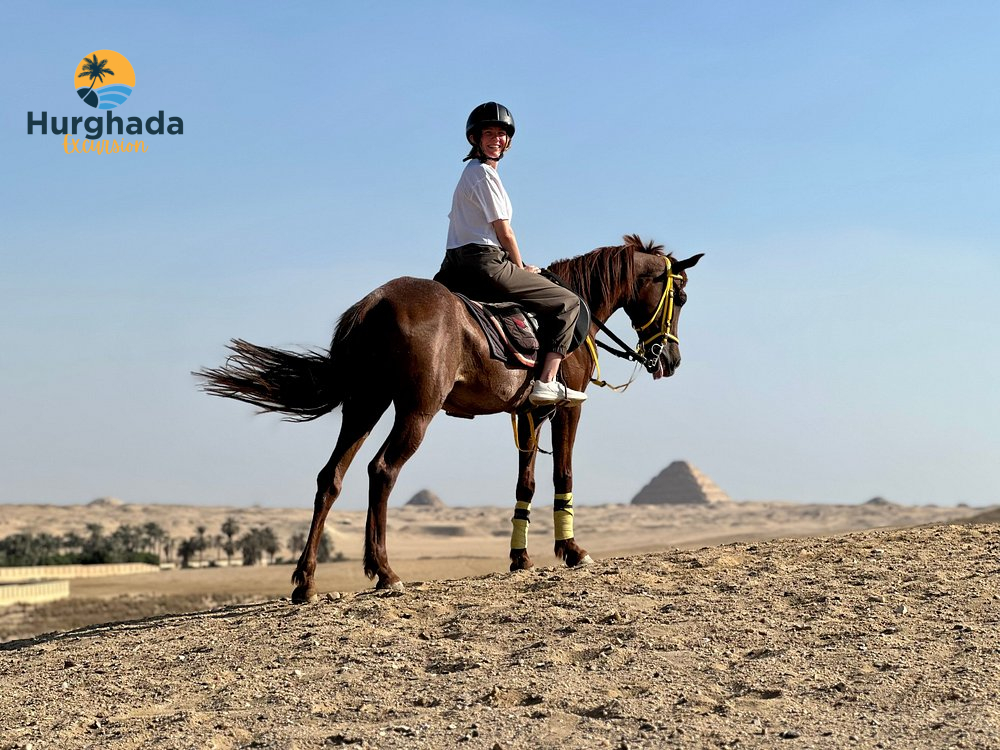
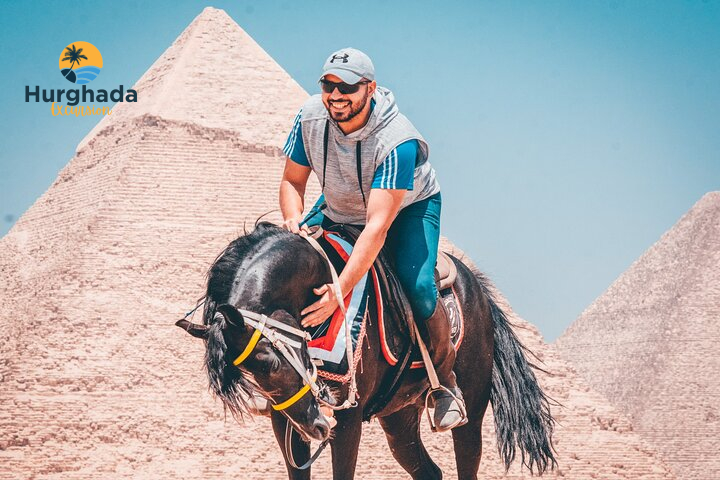
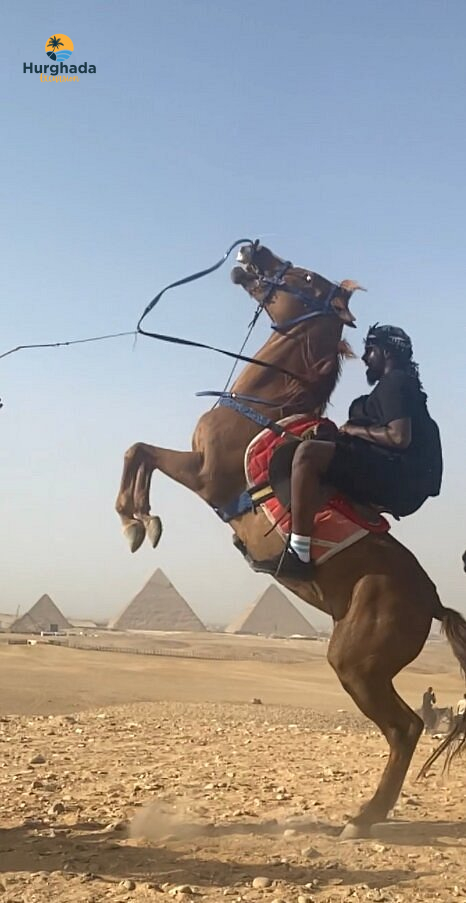
There is one photograph that every traveller who has ever stood at the Giza plateau wishes they had taken: themselves on horseback, the three Great Pyramids rising from the desert behind them, the early morning sun painting everything in amber and gold. This is not a fantasy — it is available every single morning at the Giza plateau, and it is one of the most extraordinary ways to experience one of the most extraordinary landscapes on earth. The Giza plateau horse riding experience gives you not just the photograph but the complete sensory reality that no ground-level visit can replicate: the rhythm of a horse moving beneath you through the Western Desert, the pyramids growing progressively larger as you approach them from the south, the silence of the desert broken only by the horses’ hoofbeats and the occasional distant call from the city beyond the plateau edge.
Horse riding in Egypt at Giza is a tradition stretching back centuries — the stables at the Giza plateau have been providing horses and camels to visitors since the 19th century, when European travellers first began arriving in organised tours. Today, a network of established stables operates on the edge of the plateau, offering rides ranging from a one-hour sunset circuit to a three-hour dawn ride across the full desert route with all three pyramids in sequence. Combined with the Giza plateau visit itself — the Great Pyramid interior, the Sphinx, the panoramic viewpoint — the horse riding provides a perspective on these monuments that simply cannot be replicated from the designated tourist pathways: the view from the saddle, at ground level, with the desert stretching in every direction and the 4,500-year-old stone structures filling the horizon.
🐎 Is there horse riding in Egypt? Yes — horse riding at the Giza plateau is one of Egypt’s most popular outdoor activities for tourists. Egyptian Arabian horses have been bred in the Nile Valley for over 3,000 years — the Arabian horse breed originated in the Arabian Peninsula but was developed and refined in Egypt and is deeply associated with Egyptian equestrian culture. The stables at Giza maintain herds of well-trained Egyptian Arabians specifically for plateau riding — suited to the desert terrain, comfortable with beginners, and capable of the extended rides that cover the full Giza complex. Riders at every level from complete beginners to experienced equestrians can find an appropriate horse and route at the Giza stables.
What Is the Giza Plateau Horse Riding Experience?
The Giza plateau horse riding experience is an escorted desert ride on Egyptian Arabian horses across the Giza plateau — the 5 km² limestone plateau on which the three Great Pyramids stand, surrounded on three sides by the Western Desert. Rides depart from established stables on the plateau’s southern and western edges, with routes that wind through the desert between and around the pyramids, reaching the panoramic viewpoint from which all three pyramids are simultaneously visible, and returning via the desert path along the plateau’s western edge.
| Ride Type |
Duration |
Best Time |
Price (per person) |
| Short desert circuit |
45 min – 1 hour |
Any time |
~€20–30 |
| Standard panoramic ride |
1.5–2 hours |
Morning or late afternoon |
~€35–50 |
| Sunrise / Sunset extended ride |
2–3 hours |
06:00–08:00 or 16:00–18:30 |
~€50–80 |
| Private full plateau ride |
3 hours |
Sunrise (best) |
~€80–120 per person |
Top 10 Highlights of the Giza Desert Horse Ride
📸
1. The Iconic Photograph — Horse + Three Pyramids
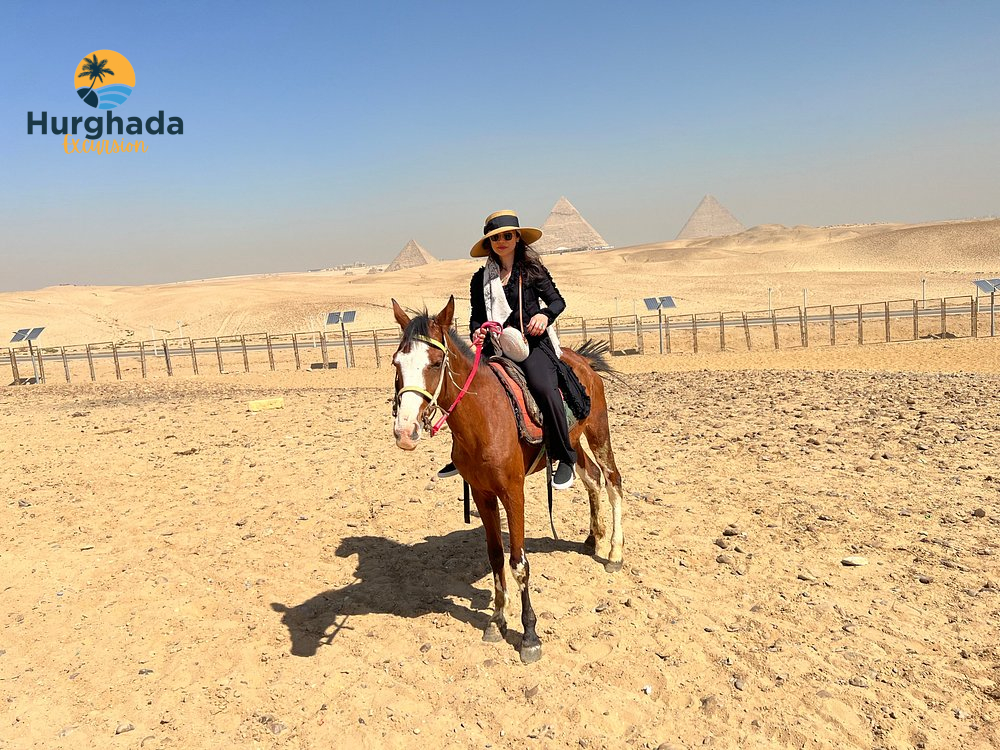
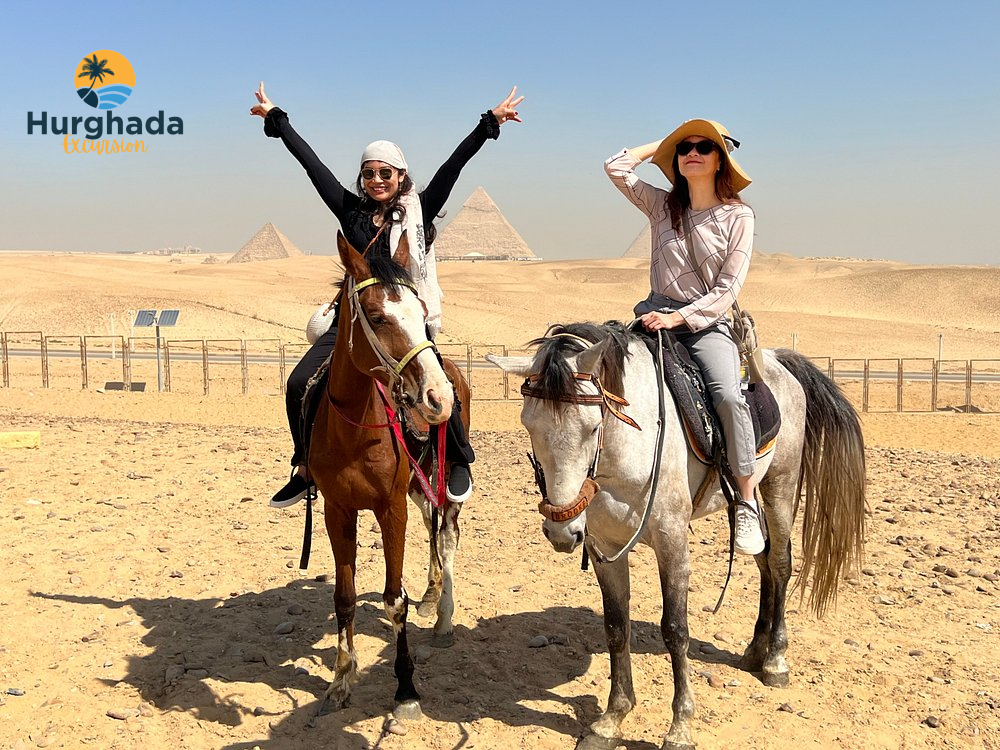
From the panoramic viewpoint reached during the extended ride, all three Great Pyramids are visible simultaneously behind the rider — the most iconic Egypt travel photograph available. The stable guide positions you at precisely the right distance and angle for the three-pyramid composition. No other activity at Giza — walking, driving, or cycling — provides exactly this perspective at exactly this visual distance.
🌅
2. Sunrise Gallop Across the Desert
The sunrise ride (departing the stables at approximately 05:30–06:00 AM) catches the plateau before any other tourists arrive — the pyramids caught in the first golden light, the desert completely empty, and the horses moving at a canter through sand that has not yet been marked by the day’s footprints. Most experienced riders describe this as the finest single riding experience available anywhere in Egypt.
🐎
3. Egyptian Arabian Horses — Ancient Breed
The horses used for Giza plateau rides are Egyptian Arabians — one of the world’s most ancient horse breeds, refined in the Nile Valley over 3,000+ years. Known for their intelligence, sensitivity, endurance in desert conditions, and extraordinary beauty (dished face, arched neck, high tail carriage), Egyptian Arabians are considered the finest of all Arabian horse varieties. Riding one beside the pyramids creates a genuine sense of historical continuity.
🏺
4. Approaching the Pyramids from the Desert
The guided horse ride approaches the Great Pyramid from the south — across open desert, without the tourist infrastructure visible from the main entrance. As the horse moves north, the pyramid grows progressively and dramatically larger in the field of view — creating the approach experience that visitors arriving by vehicle at the main gate never have. The desert approach reveals the pyramids as they were intended to be seen: rising from the horizon against the sky.
🔇
5. The Desert Silence at Dawn
Before the tourist coaches arrive and the Giza plateau fills with 10,000 daily visitors, the desert around the pyramids is genuinely silent — the only sound the rhythm of hooves on sand, the occasional snort of a horse, and the distant morning call to prayer from the city below. This silence — in one of the most visited tourist destinations on earth — is available only at dawn, only on horseback, and only for approximately 90 minutes before the day begins.
🌅
6. Sunset Ride — Golden Hour Perfection
The alternative to the sunrise ride — departing at approximately 16:00–16:30 PM when the afternoon heat has eased and the sun begins its descent toward the horizon behind Giza. The western light at this time of day illuminates the pyramids from behind (from the rider’s perspective on the eastern side), creating an extraordinary silhouette effect as the sun descends. The sky transitions through every shade of amber and red as the ride concludes.
🏜️
7. The Western Desert Edge
The extended rides include a section along the western edge of the Giza plateau where the cultivated Nile Valley ends abruptly and the Sahara begins — the boundary between green and sand-white that the ancient Egyptians called “the red land” (desert) and “the black land” (agricultural Egypt). From horseback at this edge, the extraordinary visual contrast of emerald green floodplain against the sand-coloured desert — visible simultaneously from the plateau rim — is one of the most dramatic natural landscapes in Egypt.
🐫
8. Optional Camel Ride Add-On
Most Giza stables offer camel riding as an alternative or add-on to the horse ride — camels provide a very different experience (slower, more swaying, higher off the ground) but the same extraordinary backdrop. Some operators offer combination rides: 45 minutes on horse and 30 minutes on camel, covering different sections of the plateau for a complete desert animal riding experience.
🎓
9. Suitable for All Riding Levels
Giza stable horses are selected and trained for their suitability to tourist riders of all experience levels — from complete beginners (led by a handler on a very calm, well-schooled horse for the short circuit) to experienced riders who can request a more spirited Arabian for the extended sunrise ride at canter or gallop. The guide confirms experience level at booking and assigns the appropriate horse accordingly.
🌟
10. The Most Memorable Pyramid Experience
Guests who do both the guided walking tour of the Giza plateau and the horse riding consistently describe the horse ride as the more powerful emotional experience — not because the historical content is richer (it isn’t) but because the physical sensation of moving through this landscape on a horse creates a quality of presence and immediacy that no guided tour on foot can match. The pyramids were built by a civilisation that lived with horses. The horse connects you to that world.
Complete Day Program — From Hurghada to Giza & Horse Riding
The Giza plateau horse riding from Hurghada is best combined with the standard Giza plateau tour. Here is the complete program for the sunrise ride option (the most recommended):
✈️ SUNRISE RIDE PROGRAMME (Recommended · By Flight)
Depart Hurghada ~04:00 AM · 45-min flight · Transfer to Giza stables ~06:00 AM · Sunrise horse ride (06:00–09:00) · Giza Plateau guided tour (09:30–13:00) · Grand Egyptian Museum (13:30–16:00) · Return flight ~18:00 PM · Arrive Hurghada ~19:00 PM
06:00 – 06:30 · Stable Arrival
🐎 Giza Stables — Horse Assignment & Safety Briefing
Arrival at the stable — the guide confirms the group’s riding experience levels and the stable manager assigns appropriate horses. Safety helmets are provided (helmets are mandatory for all riders on our organised tours — non-negotiable). A 10-minute safety briefing: mounting and dismounting, basic rein use, the correct position in the saddle, and the stop/go signals. For beginners, a stable handler walks alongside throughout the ride.
What to wear for horse riding at the pyramids: Long trousers (not shorts — the saddle will chafe bare legs). Closed shoes with a small heel if available (prevents the foot sliding through the stirrup). No sandals or flip-flops — footwear that can slip through the stirrup is a safety risk. Sunglasses and sunscreen. A hat that fits securely beneath the helmet. Avoid loose scarves or flowing garments that can startle the horse.
06:30 – 07:00 · Departure & Desert Approach
🌅 Riding Out into the Dawn Desert
The horses leave the stable and move into the desert — the Giza plateau at 06:30 AM is almost entirely empty of other tourists. The stable guide leads the group south across the sand, then turns north to begin the approach toward the pyramids with the rising sun behind the riders (if riding from the eastern side) or catching the pyramids in raking morning light (if approaching from the south). The transition from the stable’s edge to open desert takes approximately 5 minutes — after which the experience is genuinely that of a desert rider in an ancient landscape.
07:00 – 08:00 · The Desert Ride
🏺 Desert Circuit — All Three Pyramids & Panoramic Viewpoint
The main body of the extended ride — a circuit that moves between and around the three pyramids, with the stable guide identifying each pyramid, explaining the basic history, and leading the group to the panoramic viewpoint for the three-pyramid photograph. Experienced riders can canter or gallop on designated sections of the route. The guide stops at specific positions for photography at the best light angles.
The highlights of the desert circuit route: the approach to the Great Pyramid from the south (the pyramid filling more and more of the visual field as the horse moves north), the circuit between the Great Pyramid and the Pyramid of Khafre (the area where the difference in size between the two is most dramatically apparent), the panoramic viewpoint (all three pyramids in perfect alignment — the photograph), and the return route along the plateau’s western desert edge.
08:00 – 08:30 · Photography Stop & Return
📸 Panoramic Viewpoint Photography & Return to Stables
The guide allocates a dedicated photography stop at the panoramic viewpoint — riders are positioned with the three pyramids in the background and the stable guide takes photographs on each person’s device. This is the single most photographed moment of the ride. The return route to the stables follows the desert path along the southern plateau edge, arriving back at the stable at approximately 08:30–09:00 AM.
09:30 – 13:00 · Giza Plateau Visit
🏺 Great Pyramid · Sphinx · Valley Temple · GEM
After the horse ride and a refreshment break, the standard Giza plateau guided tour begins — the Great Pyramid (skip-the-line entry), the Sphinx and Valley Temple, the panoramic viewpoint by vehicle, and optionally the Great Pyramid interior. Lunch at a Cairo restaurant, then the Grand Egyptian Museum in the afternoon.
The Desert Routes — Sunrise, Standard & Sunset Rides
⭐ Most Recommended
Sunrise Ride (06:00–08:30 AM)
The finest light, the emptiest plateau, the most dramatic photography. Depart the stable at first light — the three pyramids catching the first amber rays of the sun as you approach from the south. The plateau is empty of other tourists for the first 60–90 minutes. Extended route covering all three pyramids and the panoramic viewpoint. Experienced riders can canter. The most emotionally powerful Giza experience available at any price.
Standard Option
Mid-Morning Ride (09:00–11:00 AM)
The most accessible timing — combined with the regular Giza plateau visit. The horse ride as the first activity (before the plateau fills with tour groups), followed by the walking visit to the Sphinx and pyramids. Good light until approximately 10:00 AM. Some tourist activity on the plateau by this time — the desert route avoids the main tourist pathways so the horse ride remains quieter than the monument visit.
Evening Option
Sunset Ride (16:00–18:30 PM)
The afternoon alternative — the plateau again begins to empty as the day-tripping tour groups depart. The sunset light at Giza is extraordinary: the limestone pyramids turn amber, then orange, then deep gold as the sun descends. The western desert behind the rider silhouettes the pyramids against the coloured sky. The most dramatic sky colours — though the pyramid illumination is less detailed than morning light.
Premium Option
Full Plateau Ride (3 hours)
The most comprehensive route — covering the complete Giza plateau perimeter, all three pyramid circuits, the panoramic viewpoint (extended time), the desert western edge route, and the eastern approach with the Sphinx visible in the distance. Suitable for experienced riders only. The extended route includes controlled canter sections on the open desert areas and gallop opportunities on the western edge for confident riders.
The Egyptian Arabian Horses — Breed & Riding Style
Is there horse riding in Egypt? Egypt has one of the world’s most distinguished equestrian traditions. Here is the complete guide to the horses at Giza:
🐎
The Egyptian Arabian
The Egyptian Arabian is considered by many breeders to be the purest and finest strain of the Arabian horse — maintained in closed breeding programmes in Egypt since ancient times. Characteristics: refined head with distinctively dished profile, large dark eyes, arched neck, short back, naturally elevated tail carriage, and exceptional endurance in desert conditions. The Giza stables’ horses are typically 14–15 hands and well-suited to the desert terrain.
📚
3,000 Years of History
Horses were introduced to Egypt during the Second Intermediate Period (c. 1650 BCE) by the Hyksos invaders — whose horse-drawn chariots gave them military superiority until the Egyptians adopted and refined the technology. The New Kingdom pharaohs (including Thutmose III and Ramesses II) were celebrated horsemen whose campaign reliefs show them in battle on horses very similar in type to the Egyptian Arabians still bred in Egypt today.
🎯
Suitable for All Levels
Beginners: Led at walk by a stable handler, on the calmest, most experienced horses in the stable. No prior riding experience needed — most beginners feel confident within 10 minutes of departure. Intermediate: Independent riding at walk and trot, with stable guide accompanying but not leading. Experienced: Independent riding at walk/trot/canter/gallop (on designated sections), on the most responsive and energetic horses available.
Camel Riding at the Pyramids — The Alternative Experience
Can you still ride camels at the pyramids? Yes — camel riding is still available at the Giza plateau and is offered by the same stables that provide horse rides. Here is the complete comparison:
🐫
Camel Ride — The Traditional Choice
More swaying, slower pace, and significantly higher off the ground than horses. The camel’s characteristic rocking motion (the reason for their nickname “ships of the desert”) is very different from a horse’s movement. Duration: typically 30–45 minutes (standard tourist camel rides are shorter than horse rides). Price: approximately €15–25 per person. The camel photograph with one pyramid is the classic tourist image; for the three-pyramid panoramic shot, the horse route is better positioned.
🐎 vs 🐫
Horse vs Camel — Which Is Better?
Choose horses for: The three-pyramid panoramic photograph · extended rides · experienced riders · the sunrise or sunset light circuit. Choose camels for: The quintessential Egypt experience · single pyramid backdrop shot · shorter rides · the classic tourist photograph. Best choice: Our combined tour includes both a horse ride (main experience, 2 hours) and a 20-minute camel ride at the panoramic viewpoint — providing both experiences and both photographs.
⚠️
Camel Ride Caution
Independent camel rides negotiated at the Giza plateau without a guide are the most common source of tourist complaints in Cairo — vendors claim a 30-minute ride costs 100 EGP and then demand payment in US dollars and attempt to charge for the camel handler’s assistance. Our tour uses pre-agreed operators with fixed prices and no on-site renegotiation. Always confirm the total price (both up and down) before mounting any camel at Giza.
The 20% Rule in Horse Riding — What It Means for Giza
What is the 20% rule in horse riding? This is one of the most common horse riding safety questions — and it is directly relevant to choosing the right horse for the Giza ride:
🐎 The 20% Rule Explained
The 20% rule in horse riding states that a horse should not carry more than 20% of its body weight — including rider plus saddle and equipment. This is a welfare guideline adopted by many equestrian organisations worldwide to protect horses from the musculoskeletal stress of carrying excessive weight.
Practical application at Giza: An average Egyptian Arabian horse at the Giza stables weighs approximately 400–450 kg. The 20% rule would indicate a maximum rider weight (including saddle ~10 kg) of approximately 80–90 kg — meaning a maximum rider weight of approximately 70–80 kg. Heavier riders should notify the stable at booking — larger, stronger horses are available at good Giza stables and the stable manager will assign an appropriate horse for any rider weight.
Our policy: We confirm rider weights at booking and ensure the appropriate horse is assigned. We do not assign a horse that would be carrying more than 20% of its body weight — and we refuse to work with stables that do not apply equivalent welfare standards. If a rider’s weight means no appropriate horse is available at that stable, we arrange an alternative stable or activity without additional charge.
The Photography — Getting That Perfect Pyramids Shot
The horse ride at Giza produces the finest individual travel photographs available at the pyramids. Here is the complete photography guide:
⏰
The Best Light — Sunrise vs Sunset
Sunrise (06:00–08:00 AM): Front-lit pyramids (sun behind the rider from the east, illuminating the pyramid faces) — maximum detail in the stone, warm amber tones, blue sky. Sunset (16:00–18:00 PM): Back-lit pyramids (sun behind the pyramids from the west) — dramatic silhouette effect, coloured sky backgrounds, more atmospheric but less detail on the stone. Most professional photographers prefer sunrise for the stone detail; most Instagram photographers prefer sunset for the sky drama.
📐
The Three-Pyramid Composition
The panoramic viewpoint where all three pyramids are simultaneously visible in correct alignment is approximately 800 metres south of the Great Pyramid — accessible only via the desert route taken by the horse ride (not from the main tourist pathways). The stable guide positions riders at the precise distance and angle for the alignment. For this specific photograph, the extended ride (1.5+ hours) is required — the short circuit does not reach this viewpoint.
📱
Camera Handling on Horseback
Smartphone cameras perform very well on the Giza horse ride — the horses move at a walk for most of the route and the stable terrain is relatively flat, producing minimal vibration. Secure your phone with a wrist strap or lanyard. The stable guide takes photographs for the group from the ground — the best shots are the guide’s images from slightly ahead and to the side of the rider, capturing the pyramids over the rider’s shoulder.
💡
The Photography Stop
All extended rides include a designated 15–20 minute photography stop at the panoramic viewpoint — the group halts, dismounts if desired, and the stable guide takes turns photographing each person (and couple or family) with the three pyramids in perfect background alignment. Bring a selfie stick or a remote shutter for self-portraits without the guide’s assistance.
Giza Plateau Entry Fee & Horse Riding Price 2026
How much to enter the Giza plateau? And how much does the horse riding cost? Here is the complete 2026 pricing:
| Item |
Price (EGP) |
Approx. EUR |
Notes |
| Giza Plateau Entry (Adult) |
~540 EGP |
~€10 |
Included in tour · open 08:00–17:00 |
| Horse Ride — Short (45 min) |
~1,100–1,700 EGP |
~€20–30 |
Included in tour (short circuit) |
| Horse Ride — Extended (2 hours) |
~2,800–4,400 EGP |
~€50–80 |
Recommended · sunrise/sunset |
| Camel Ride (30–45 min) |
~800–1,400 EGP |
~€15–25 |
Optional add-on · classic tourist experience |
| Great Pyramid Interior (optional) |
~1,000 EGP |
~€18 |
Optional premium · King’s Chamber access |
Tour Price from Hurghada 2026 — What’s Included
Giza Horse Riding + Pyramids Tour from Hurghada — From
€100
per adult · By flight · Horse ride (2h) + Giza Plateau visit + GEM
✓ Flights · ✓ Transfers · ✓ Horse Ride · ✓ Giza Entry · ✓ Egyptologist Guide · ✓ Lunch
Children 4–11: 50% discount · Horse riding minimum age: 7 years · Weight limit: see 20% rule above
✅ Included
✓ Return flights Hurghada – Cairo – Hurghada (45 min each way)
✓ All transfers (airport – stables – Giza plateau – GEM – airport)
✓ Extended horse ride (2 hours) with safety helmet · stable guide
✓ Giza plateau entry ticket (~540 EGP) · Valley Temple · Sphinx visit
✓ Grand Egyptian Museum standard entry (~1,000 EGP)
✓ Licensed Egyptologist guide · Full lunch · Bottled water · Free cancellation 48 hours before
Best Time for Horse Riding at the Pyramids
| Season |
Dawn Temp |
Riding Comfort |
Light Quality |
Verdict |
| Oct – Nov |
18–22°C |
Excellent |
Warm, golden |
Ideal |
| Dec – Feb |
8–14°C |
Good — bring layers |
Crisp, brilliant |
Best photography · warm jacket needed |
| Mar – May |
18–28°C |
Good |
Very good |
Very Good |
| Jun – Sep |
26–32°C |
Sunrise essential · evening good |
Hazy but atmospheric |
Sunrise or sunset only — not midday |
10 Expert Tips for Your Giza Plateau Horse Ride
Tip 1 — Book the sunrise ride — it is incomparably better than any other time of day. The Giza plateau at dawn is one of the most extraordinary places on earth for a horse rider: no tourist buses, no crowds, the pyramids in the first light, the desert silent. The difference between the sunrise horse ride at 06:00 AM and a mid-morning ride at 10:00 AM is the difference between having the ancient world to yourself and sharing it with 500 other visitors. If the logistics of an early departure from Hurghada allow it — and the flight programme makes it entirely possible — choose sunrise without hesitation.
Tip 2 — Wear long trousers — not shorts or skirts. The saddle will chafe bare legs over a 2-hour ride. Light long trousers (linen or cotton) are the most comfortable riding legwear in the Egyptian heat. If you have arrived in Egypt without suitable trousers, most stables have lightweight cotton leggings available to borrow.
Tip 3 — Always wear the safety helmet — regardless of experience level. Our tours require safety helmets for all riders at all experience levels. This is not negotiable. Independent riders who negotiate directly with stables at Giza are often offered rides without helmets — this is a serious safety risk that we do not accept. Helmets are provided by the stable and sized at departure. If a stable offers to skip the helmet “since you are experienced,” decline and insist on wearing one.
Tip 4 — Ask the stable guide to take your photograph — don’t only take selfies. The best photograph of a rider on horseback with the pyramids in the background is taken from slightly ahead and to the side of the rider by someone standing on the ground — not a selfie from the saddle. The stable guide does this as a matter of course at the panoramic viewpoint, taking turns photographing each person. Give the guide your phone, confirm the composition you want, and get the shot you came for.
Tip 5 — Request a particular horse characteristic rather than a specific horse. If you are a competent rider who wants a more responsive, energetic horse — tell the stable manager “I want a horse with forward energy, I am comfortable with a strong trot and canter.” If you are a beginner or nervous rider — “I want the calmest, most reliable horse you have, I will be at walk the whole time.” Good stables will match you appropriately; do not simply accept the horse you are assigned without communicating your preference.
Tip 6 — The panoramic viewpoint requires the extended ride — confirm it is included before departing. Not all “horse rides at the pyramids” reach the panoramic viewpoint where the three-pyramid photograph is taken. Some short circuit rides only circle the nearest pyramid and return. Confirm with the guide before mounting that the extended route includes the panoramic viewpoint. Our tour packages specifically include this viewpoint as the photographic highlight of the ride.
Tip 7 — Negotiate the complete price before mounting — and confirm “no extras.” Independent travellers at Giza are sometimes surprised by additional charges at the end of a horse or camel ride — for the handler’s time, for water, for a shorter route than agreed, or for photographs. Our pre-arranged tours have all prices fixed and confirmed in advance. If booking independently, always confirm the complete price before mounting, specify the exact route and duration, and confirm that the agreed price is the complete total with no additional fees.
Tip 8 — Bring EGP cash for tips and optional purchases. The stable guide who leads your ride and takes your photographs works for tips in addition to the stable fee. A tip of approximately 100–200 EGP per rider (approximately €2–4) is appropriate and appreciated — the guide’s quality of service, including the quality of the photographs taken, is directly motivated by this expectation of gratuity. Bring small EGP notes.
Tip 9 — Begin the horse ride before the Giza plateau visit — not after. The horse ride at dawn and the Giza plateau walking visit mid-morning are perfectly sequenced — the empty plateau at dawn for the ride, then the increasingly busy plateau from 09:00 onwards for the monument visit. Do not do the walking tour first and then the horse ride — by the time the walking tour concludes in late morning, the desert heat and the number of other visitors make the horse ride significantly less pleasant than the dawn version.
Tip 10 — This is the experience that makes the pyramids feel like the living ancient world rather than a tourist site. The pyramids from the designated tourist walkways, surrounded by other visitors and vendor stalls, are magnificent but managed. The pyramids from horseback at dawn, with no one else in the desert, approached from the south at a canter — this is how generations of travellers before the tourist age experienced them. Alexander the Great approached Egypt from the west. Napoleon stood here at dusk. Every traveller before the 20th century saw these pyramids from horseback or camelback. The ride gives you their perspective — and it is extraordinary.
Real Reviews from Travellers
★★★★★
“The sunrise horse ride at the pyramids was the single most extraordinary experience of our entire two-week Egypt trip. The plateau was completely empty. The guide positioned us at the panoramic viewpoint with all three pyramids behind us in the first golden light. We were cantering through the desert with 4,500-year-old pyramids filling the horizon. The photograph is framed on our living room wall. Nothing in Egypt came close to this.”
James & Sarah K. — Edinburgh · March 2026
★★★★★
“I have ridden horses in Argentina, Mongolia, and Iceland. The Giza plateau horse ride at sunrise beats all of them for sheer improbable beauty. An Egyptian Arabian at a canter across the Western Desert with the Great Pyramid filling the sky ahead of you is genuinely the most extraordinary riding experience I have had anywhere. The guide was excellent, the horses were beautiful, and the photograph is ridiculous.”
Caroline R. (experienced rider) — London · February 2026
★★★★★
“Neither of us had ridden a horse before. We told the guide and he assigned us the two calmest horses at the stable, had a handler walk alongside for the first 20 minutes, and by the time we reached the panoramic viewpoint we were both riding independently at a walk with complete confidence. The three-pyramid photograph is the most beautiful travel photograph we have ever taken. Do this.”
David & Helen T. (first-time riders) — Manchester · January 2026
Frequently Asked Questions
Is there horse riding in Egypt at the pyramids?
Is there horse riding in Egypt? Yes — horse riding at the Giza plateau is one of Egypt’s most popular outdoor tourist activities. Established stables on the plateau’s southern and western edges offer rides ranging from 45-minute short circuits to 3-hour extended dawn rides. The horses are Egyptian Arabians — one of the world’s oldest and most refined horse breeds. Rides are available for all experience levels from complete beginners (led by a handler at walk) to experienced riders (independent riding at canter/gallop on extended routes). Best time: sunrise (06:00–08:30 AM) for the finest light, emptiest plateau, and most dramatic photography.
What is the 20% rule in horse riding?
What is the 20% rule in horse riding? The 20% rule states that a horse should not carry more than 20% of its body weight (rider + tack). For an average Egyptian Arabian at the Giza stables (~400–450 kg), this means a maximum rider weight of approximately 70–80 kg. Heavier riders should notify us at booking — larger horses are available. We enforce the 20% rule as a horse welfare standard and do not assign horses that would be carrying excessive weight.
How much to enter Giza plateau and what does the horse riding cost?
How much to enter the Giza plateau? Approximately 540 EGP (~€10) per adult (card payment only).
Horse riding price at Giza: Short ride (45 min): approximately €20–30 per person. Standard panoramic ride (1.5–2 hours): approximately €35–50. Extended sunrise/sunset ride (2–3 hours): approximately €50–80. Private full plateau ride (3 hours): approximately €80–120. Our all-inclusive package from Hurghada (flight + 2-hour horse ride + Giza plateau visit + GEM): from €100 per adult.
Can you still ride camels at the pyramids?
Can you still ride camels at the pyramids? Yes — camel riding is still available at the Giza plateau in 2026, offered by the same stables that provide horse rides. Standard camel rides last 30–45 minutes and cost approximately €15–25 per person. Important caution: independently negotiated camel rides at Giza without a guide are the most common source of tourist complaints — prices quoted in Egyptian pounds change to US dollars at dismount, handlers demand payment for unsolicited assistance, and agreed ride durations are shortened. Our tour uses pre-negotiated operators with fixed prices and no on-site renegotiation.
Book Your Giza Plateau Horse Riding Today
From €100 per person by flight from Hurghada · 2-hour sunrise horse ride · Egyptian Arabian horses · Three-pyramid panoramic photograph · Giza plateau visit · Grand Egyptian Museum · Egyptologist guide · All inclusive.
🐎 Book Now — From €100
The Giza plateau horse riding experience — desert ride with pyramids background — provides the single most extraordinary perspective on the Great Pyramids of Giza available to any visitor. Not the largest, not the most historically detailed, not the most archaeologically comprehensive — but the most immediately and viscerally powerful. The experience of approaching the pyramids on horseback across the open desert at dawn, watching them grow from a distant silhouette to an overwhelming presence on the horizon, then turning at the panoramic viewpoint with all three in perfect alignment behind you and the Egyptian sun just clearing the eastern horizon, is genuinely and permanently life-changing. The photograph proves you were there. The memory goes deeper than photographs.
Book your Giza plateau horse riding today with Hurghada Excursion — Egyptian Arabian horses, safety helmets, the panoramic three-pyramid viewpoint, and the most extraordinary desert riding experience available from the Red Sea coast.