
Hurghada Stargazing Experience with Telescope and Dinner
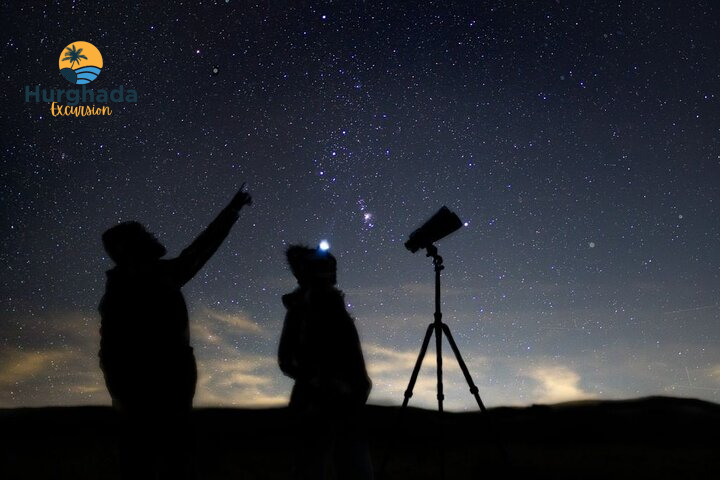
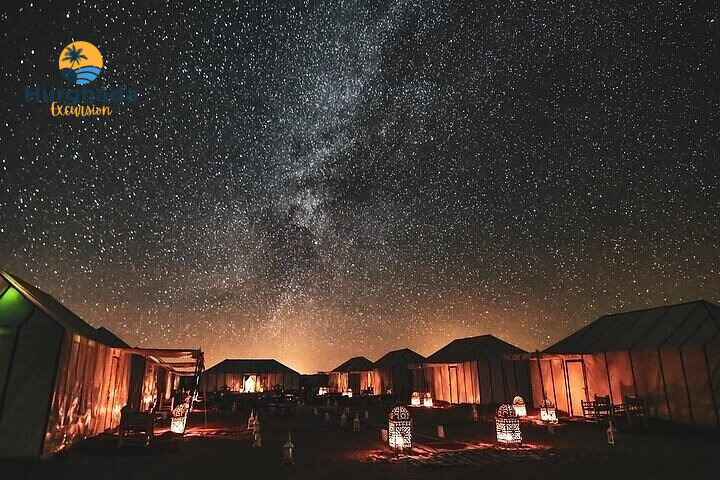
There is a moment that every guest describes when they write about the Hurghada Stargazing Experience with Telescope and Dinner — a moment that does not appear in any brochure or online listing because no description adequately prepares you for it. You step out of the vehicle at the desert camp, 30 kilometres from Hurghada‘s coastal lights, and you look up. Not because the guide asks you to. Not because you remembered to. But because the sky above you is nothing like any sky you have ever seen — the Milky Way visible not as a faint smudge but as a luminous, textured, three-dimensional band of hundreds of billions of stars arching from one horizon to the other, so bright that it illuminates the sand beneath you with a faint silver light. For most guests from cities in Europe, North America, and Asia, this is the first time in their lives they have seen the real night sky — the sky that existed over every human civilisation for 99.9% of human history, before electric light erased it from all but the most remote corners of the planet.
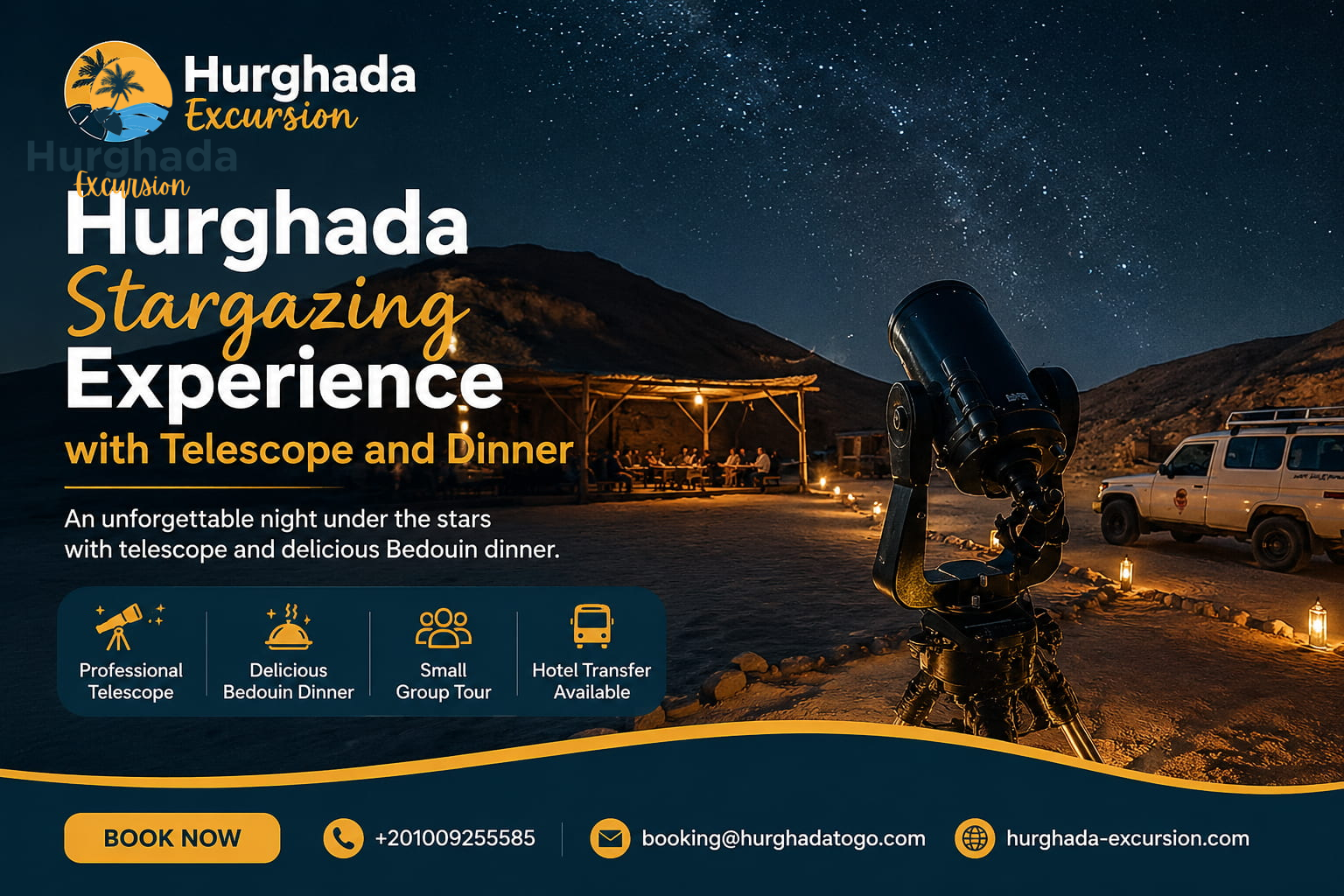
The Hurghada Stargazing Experience with Telescope and Dinner is built around this moment — and everything else in the evening programme is designed to deepen and extend it. The professional astronomer guide uses a high-powered telescope to bring Saturn’s rings, Jupiter’s moons, the craters of the Moon, and the glowing gas of the Orion Nebula to within apparent touching distance. The traditional Bedouin dinner, cooked over an open fire, feeds the body while the sky feeds something deeper. The laser pointer constellation tour turns the overhead stars into a comprehensive map of human mythology, science, and ancient Egyptian cosmological belief. And through it all, the Eastern Desert surrounds the camp in complete, profound silence — the rarest luxury available from any Hurghada excursion, and the most lastingly remembered.
🔭 What Is the Hurghada Stargazing Experience with Telescope?
The Hurghada Stargazing Experience with Telescope and Dinner is a 4–5 hour evening excursion to a dedicated astronomical observation site in the Eastern Desert, approximately 30 km west of Hurghada city, where Bortle Class 2–3 sky darkness makes it one of the finest natural stargazing locations in the entire Middle East and North Africa region. The programme combines a professional telescope observation session (Saturn’s rings, Jupiter’s four Galilean moons, the Orion Nebula, deep-sky clusters), a laser pointer constellation tour with complete mythology and ancient Egyptian astronomical tradition, a traditional Bedouin dinner prepared over an open fire, and the extraordinary natural experience of lying on the desert sand under the complete Milky Way in profound, undisturbed desert silence.
| Detail | Standard Group Tour | Private VIP Camp |
|---|---|---|
| Duration | 4–4.5 hours | 5–6 hours (fully flexible) |
| Pickup Time (Summer) | 18:00–19:00 (seasonal) | Your preferred time |
| Pickup Time (Winter) | 16:30–17:30 (seasonal) | Your preferred time |
| Languages | English · Arabic | + German · French · Russian · Italian |
| Min. Age | All ages welcome | All ages · family packages available |
📑 Table of Contents
Why the Eastern Desert Near Hurghada Is Perfect for Stargazing
The Eastern Desert of Egypt — the vast, largely uninhabited wilderness between the Nile Valley and the Red Sea coast — has been recognised by professional astronomers as one of the finest natural observation environments in the northern hemisphere. Here is why it produces stargazing of such exceptional quality:
Top 12 Highlights of the Hurghada Stargazing Experience with Telescope
Complete Evening Itinerary — Hurghada Stargazing with Telescope
Here is the complete Hurghada Stargazing Experience with Telescope and Dinner itinerary — from hotel pickup through every activity to the return:
🚌 Hotel Pickup · Transit Briefing · Approaching the Dark
Pickup from your Hurghada hotel at the seasonal time (see timing table below). The guide provides the evening briefing during the 40-minute drive into the Eastern Desert — covering the Bortle Scale sky quality at the camp, the programme for the evening, the telescope equipment, and the dark adaptation protocol (why phone screens destroy night vision, why the guide uses only red light, why the fire will be dimmed during the observation session).
During the drive, guests can observe the sky above the vehicle windows darkening progressively as the distance from Hurghada‘s light dome increases. By 20 km from the city, the Milky Way begins to appear. The astronomer marks the moment for the group — “You can see it now” — as the first stars of the galactic band become visible from the moving vehicle.
🌅 Desert Camp Arrival · Welcome Tea · Sunset & First Stars
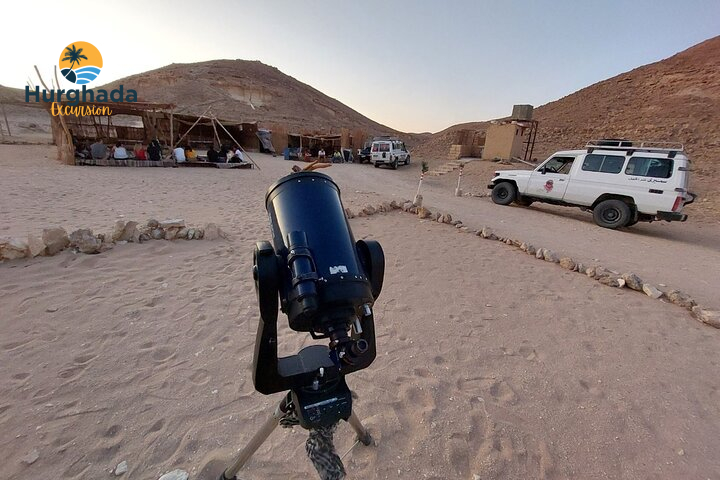
Arrival at the desert camp as the sun is setting or has just set — the sky transitioning from deep orange to rose to purple to the first blue-black of astronomical twilight. The Bedouin host performs the traditional welcome tea ceremony — sweet mint tea poured from height, the formal opening of Bedouin hospitality. Guests sit on cushions outside the tent and watch the sky darken.
The astronomer uses this twilight period to explain dark adaptation — the 20–30 minute period required for the eyes to reach maximum sensitivity in low light. During this period, the astronomer asks all guests to avoid phone screens and bright lights. The camp uses only red-filtered torches throughout the evening — red light does not disrupt dark adaptation (because the rod cells in the retina responsible for low-light vision are not sensitive to red wavelengths).
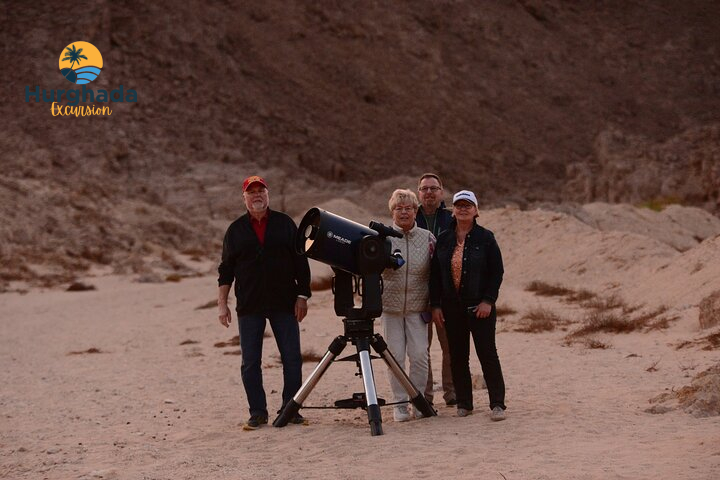
The astronomer sets up the telescope during the twilight period — a Celestron 8-inch Schmidt-Cassegrain or equivalent professional reflector, aligned to the celestial north pole using a laser pointer and the polar alignment eyepiece. When the alignment is confirmed, the astronomer targets the first bright object: typically Venus or Jupiter, which appear in the fading twilight before any stars are visible.
🪐 Twilight Planet Views — First Telescope Looks While Sky Darkens
The first telescope session — while the sky is still in astronomical twilight (not yet fully dark but with the brightest planets already visible). The astronomer focuses on the planets that are currently in the evening sky — depending on the date, this may include Venus (phases visible through the telescope — a tiny crescent or gibbous form depending on orbital position), Jupiter (already showing cloud bands and moons in twilight), or Saturn.
This session serves a dual purpose: it allows guests their first telescope views while the eyes are still adjusting (so the impact of the full dark sky session is maximised by contrast), and it allows the astronomer to calibrate the telescope precisely using the planet as a reference object. By the end of this session, the astronomer has confirmed the telescope’s perfect collimation and tracking for the main session ahead.
🍽️ Traditional Bedouin Dinner — Fire Cooking · Desert Hospitality
Dinner is served under the open sky with the full Milky Way now overhead — the Bedouin camp fire providing the only light in the immediate environment. The fire’s orange glow creates a beautiful counterpoint to the starfield above — guests can look up from their food directly into one of the finest natural spectacles available anywhere in the region.
Hummus · Tahini · Babaganoush · Fresh salads · Pickles · Sand-baked flatbread
Grilled chicken or slow-cooked lamb · Kofta · Egyptian rice · Grilled vegetables
Om Ali · Fresh fruit · Pastries · Unlimited Bedouin tea · Soft drinks · Water
The dinner period serves the additional astronomical purpose of completing the group’s dark adaptation — the 20–30 minutes since leaving direct phone screen use and entering the camp’s red-light environment allows the rod cells to reach near-maximum sensitivity. By the time dinner concludes and the main telescope session begins, the group’s eyes are optimally prepared for the finest night sky observation the Eastern Desert can provide.
🔭 Professional Telescope Session — Saturn · Jupiter · Deep Sky
The centrepiece of the evening — a 75-minute guided telescope session in fully dark-adapted conditions with the Milky Way at its peak brightness overhead. The fire is dimmed to its lowest level to protect night vision. Blankets and cushions are arranged around the telescope for guests to lie comfortably while waiting for their turn at the eyepiece, observing the naked-eye sky.
Phase 1 — The Saturn Sequence (20 minutes): The astronomer focuses on Saturn — centring it in the highest-quality eyepiece and presenting it at the magnification that best resolves the ring system (typically 100–150×). Each guest takes their time at the eyepiece — no rushing. The astronomer explains the physical structure of the ring system (composed of water ice and rock, ranging from dust to boulders, maintained in their planar orbits by gravitational resonances with Saturn’s moons), the planet’s rapid rotation (10.7-hour day), and why the ring tilt visible from Earth changes over a 29-year cycle. On nights when Saturn’s rings are at maximum tilt toward Earth (every 14–15 years), the view is spectacular even at low magnification.
Phase 2 — Jupiter and Galilean Moons (20 minutes): The telescope moves to Jupiter — the largest planet in the solar system, visible as a clearly disk-shaped object (unlike stars which are true points even at maximum magnification). The Galilean moons are identified individually: Io (most volcanically active object in the solar system), Europa (ocean of liquid water beneath the ice — one of the most promising locations for extraterrestrial life), Ganymede (the largest moon in the solar system, larger than the planet Mercury), and Callisto (the most heavily cratered surface in the solar system — its surface has not changed for 4 billion years).
Phase 3 — Deep-Sky Objects (35 minutes): Seasonal selection — the astronomer chooses the finest objects currently well-positioned in the sky. The Orion Nebula (M42) in winter — a glowing gas cloud visible as a greenish-grey patch around the four Trapezium stars, its colour the result of hydrogen gas fluorescing under ultraviolet radiation from the young stars it contains. The Pleiades cluster — 7 hot blue stars visible to the naked eye, dozens more through binoculars, hundreds through the telescope. On the finest nights, the Andromeda Galaxy — 2.5 million light-years away, the most distant object visible to the naked eye, the oldest light you will ever see.
🌟 Green Laser Constellation Tour · Three Traditions · One Sky
Guests lie on blankets and cushions on the desert sand — looking directly up at the complete Milky Way overhead. The astronomer uses the green laser pointer to trace each constellation’s outline against the stars, identifying the key stars by their Arabic names and explaining the mythology of each in the three traditions: Greek/Roman, Arabic/Islamic, and ancient Egyptian.
The ancient Egyptian astronomy narrative is unique to this desert setting — delivered while lying on the same desert sand that ancient Egyptians lay on to make their astronomical observations 5,000 years ago. The astronomer points out the star Sirius (the brightest in the sky, blazing white) and explains: “This star told every ancient Egyptian when the Nile was going to flood. It disappeared from the sky for 70 days, then reappeared on the eastern horizon at dawn just before the flood arrived. They called it Sopdet, they built their temples to align with it, and they organised their entire agricultural year around its rising. This same star. Tonight. Above us.”
📸 Milky Way Photography Session · Camera Settings · Group Shot
The astronomer assists each guest individually with their Milky Way photography — confirming settings, helping with focus, and timing the exposure during the period of maximum sky transparency. For smartphone users: dedicated astrophotography or night mode, minimum 25-second exposure where available. For DSLR/mirrorless: 25–30 seconds, f/2.8 or widest available, ISO 3200, manual focus to infinity (confirm with live-view zoom on a bright star).
The signature group photograph of the evening — the astronomer positions the group in front of the camp fire, pointing upward toward the Milky Way, and takes a 30-second exposure that captures both the fire-lit faces in the foreground and the complete Milky Way arc overhead. This image is shared via WhatsApp before the group leaves the camp site.
🌙 Farewell Tea · Return Drive · Hotel Dropoff
A final glass of Bedouin tea at the camp before departure. The return drive to Hurghada — the desert stars visible through the vehicle windows throughout the 40-minute transit. The astronomer is available for questions throughout the return journey. Hotel dropoff approximately 23:30–00:00 depending on the seasonal departure time. The astronomer shares the evening’s photographs (including the group Milky Way image) via WhatsApp during the return drive.
The Telescope Session — What You See & Why It’s Extraordinary
| Object | Distance | What You See | Season |
|---|---|---|---|
| Saturn + Rings | 0.8–1.6 billion km | Ring system · Cassini Division · planet disc · golden colour | Year-round when above horizon |
| Jupiter + 4 Moons | 0.6–0.9 billion km | Cloud bands · Io · Europa · Ganymede · Callisto | Year-round when above horizon |
| The Moon | 384,400 km | Crater walls · mountain ranges · maria · boulder fields | When not new moon |
| Orion Nebula (M42) | 1,344 light-years | Glowing gas cloud · Trapezium cluster · greenish-grey glow | October – March (best Dec–Feb) |
| Pleiades Cluster | 444 light-years | 7 naked-eye stars · dozens through eyepiece · blue-white stars | October – March |
| Andromeda Galaxy (M31) | 2.5 million light-years | Faint smudge of ancient light · visible naked-eye on best nights | August – January (best Oct–Nov) |
Constellation Tour & Ancient Egyptian Astronomy
The Bedouin Dinner — Menu, Fire Cooking & Desert Tradition
The traditional Bedouin dinner is not simply the meal in the middle of the stargazing evening — it is a complete cultural experience that connects the astronomical programme to the human tradition of desert living that used these same stars for navigation and agriculture for millennia. The Bedouin family who runs the camp has lived in the Eastern Desert for generations — the hospitality they offer is not performance but practice.
Astrophotography at the Hurghada Stargazing Experience
| Camera Type | Recommended Settings | Expected Result |
|---|---|---|
| iPhone 14+ / 15 / 16 | Night mode · longest available exposure · stabilise on ground or tripod | Clear Milky Way · individual stars · good colour |
| Samsung Galaxy S22/S23/S24 | Expert RAW or Pro mode · 25s exposure · ISO 6400 · f/1.8 | Excellent Milky Way · galaxy structure visible |
| DSLR (Nikon / Canon) | 25–30s · f/2.8 (widest) · ISO 3200 · manual focus to infinity | Professional-quality Milky Way image |
| Mirrorless (Sony / Fuji) | 25s · f/2.0 or widest · ISO 3200–6400 · manual · star eater off | Outstanding results · best low-light performance |
Included & Not Included — Complete Tables
✅
Included
❌
Not Included
📋 Tour Quick Reference
| Detail | Standard Group Tour | Private VIP Camp |
|---|---|---|
| Duration | 4–4.5 hours | 5–6 hours (fully flexible) |
| Pickup Time (Summer) | 18:00 (June–September) | Flexible |
| Pickup Time (Winter) | 16:30 (December–February) | Flexible |
| Return Time | ~23:30–00:00 | Flexible — your request |
| Languages | English · Arabic | + German · French · Russian · Italian (48h notice) |
| Group Size | 2–25 (shared group) | 2–15 (private camp) |
Best Season — Monthly Sky Guide for Hurghada Stargazing
| Month | Sky Highlights | Camp Temp | Verdict |
|---|---|---|---|
| Jan – Feb | Orion · Sirius · Pleiades · Orion Nebula — best winter sky | 10–16°C | Outstanding · bring warm jacket |
| Mar – May | Leo · Virgo · Jupiter at its best · spring transition sky | 18–24°C | Ideal — comfortable temperatures |
| Jun – Aug | Milky Way core overhead · Saturn at opposition · Scorpius | 24–28°C | Peak Milky Way season · warmest nights |
| Sep – Oct | Andromeda Galaxy · Summer Triangle · Milky Way setting | 20–26°C | Excellent · transition season |
| Nov – Dec | Geminids meteor shower (Dec 13) · Orion rising · Taurids (Nov) | 14–20°C | Excellent · meteor shower highlights |
Hurghada Stargazing Experience Price 2026
| Option | Price | For | Notes |
|---|---|---|---|
| Standard Group Tour | €35/adult · €18/child | 2–25 guests (shared) | Best value · joins existing group |
| Private VIP Camp (2–8) | €200/group | 2–8 guests | Private camp · private astronomer · flexible |
| Private VIP Camp (8–15) | €280/group | 8–15 guests | Full private camp + extra telescope |
| Honeymoon/Special Occasion | +€50 above private | 2 guests | Private tent · rose petals · cake · star certificate |
Combine with Other Hurghada & Egypt Excursions
The Stargazing Experience is an evening programme — leaving your mornings and afternoons free for Red Sea marine activities and your subsequent days open for Egypt’s cultural sites. Here are the finest combinations:
10 Expert Tips for the Best Stargazing Experience
Tip 2 — Do not look at your phone screen during the 20 minutes before and during the observation session. Dark adaptation — the eye’s adjustment to low light — takes 20–30 minutes and is instantly reversed by any bright light source, including a phone screen at normal brightness. The astronomer guide will explain this at the start of the evening and ask for phones to be used in red night-mode only (available as an app or manual setting on most smartphones). The red light filter preserves dark adaptation while still allowing navigation at the camp site. This one habit change makes a measurable, visible difference to the quality of what you can see.
Tip 3 — Lie flat on the desert sand during the constellation tour — standing position limits your field of view. The optimal position for naked-eye stargazing is lying on your back with the entire sky filling your field of vision from horizon to horizon. The desert sand retains warmth from the day’s sun — it is comfortable to lie on, and the blankets provided at the camp add additional padding. Standing up and looking overhead provides a limited, neck-straining view of approximately 30% of the visible sky. Lying flat provides 100%. The constellation tour and the silent Milky Way period are designed for the lying position — the astronomer will invite the group to lie down before beginning.
Tip 4 — When you look through the telescope at Saturn — take your time. The most common mistake at the telescope eyepiece is looking for 5 seconds and stepping back. The first 5 seconds are spent convincing the brain that what it sees is real — that the perfectly formed disc with rings is not an image or a model but a planet 1.4 billion kilometres away. The second 10 seconds begin to reveal detail: the colour gradient from the planet’s equatorial zone to the polar regions, the slight yellowing of the rings relative to the planet’s warmer colour, the thin dark shadow of the ring system on the planet’s face. The astronomer will hold the telescope and maintain the target — stay at the eyepiece for at least 30 seconds.
Tip 5 — Bring a warm jacket even in summer — the desert temperature drop after sunset is dramatic and fast. The Eastern Desert temperature at 22:00 in July can be 20°C lower than the Hurghada coastal temperature at the same time. The desert has no ocean thermal mass, no buildings retaining daytime heat, and no humidity buffer — the temperature drops from the moment of sunset. Guests in T-shirts who have come directly from a Hurghada beach afternoon consistently report feeling cold by 21:00 at the camp. The astronomer guide will remind guests before departure — but bring a jacket regardless of how warm the departure feels.
Tip 6 — Ask the astronomer which planets are currently well-positioned — and request a specific deep-sky object. The astronomer plans each evening’s programme based on what is currently well-placed in the sky. Before the telescope session, ask specifically: “Which planets are at their best right now?” and “What is the finest deep-sky object we can see tonight?” The astronomer will add your requested targets to the programme. Saturn at opposition (when it is closest to Earth and brightest) is a specific date each year — the astronomer can advise whether the current date is near or far from opposition, which affects the ring detail visible at maximum magnification.
Tip 7 — For the astrophotography session — bring a small tripod, not just your phone. Hand-holding a 25–30 second exposure produces a blurred image regardless of the smartphone’s image stabilisation. A small, portable tripod (available online for €15–25) is the single most useful additional item for Milky Way photography at the camp. The astronomer provides a tripod loan service for guests who request it — confirm availability at booking. The camp surface (flat, firm desert sand) is ideal for tripod placement.
Tip 8 — The sand-baked desert bread at dinner is the most authentic food experience — eat it hot from the desert floor. The traditional Bedouin flatbread (aish fi raml) — placed directly on the hot desert sand and covered with glowing embers — is unique to the desert camp experience and unlike any bread produced in a conventional oven. It must be eaten hot and immediately. The astronomer guide recommends tasting the bread before any other food at the dinner table — while it is still warm from the desert floor, the combination of slight sand smokiness and the soft, chewy interior is at its most distinctive.
Tip 9 — The silence period is the most underestimated part of the evening — embrace it. When the astronomer says “Listen” and the group falls into silence under the Milky Way, the instinct is to fill the quiet with comments, questions, or phone activity. Resist this. The designated 3–5 minute silence periods are the moments that guests most consistently describe in reviews as the most unexpectedly powerful of the entire evening — the moment when the scale and antiquity of the universe overhead connects with the completeness of the desert silence below and produces something that is genuinely difficult to name. It happens every clear night at the Eastern Desert camp. It requires only your silence to reveal it.
Tip 10 — Book the stargazing for the second half of your Hurghada holiday, not the first night. Guests who do the Stargazing Experience with Telescope on their first evening in Hurghada often find it disorienting — jetlagged, unfamiliar with the surroundings, not yet settled into the holiday. Guests who do it 3–4 nights into their stay — already relaxed, tanned, acclimatised — describe the evening as the perfect culmination of the holiday’s first phase, and the most lasting memory they carry home. Book it for Day 3 or Day 4, when you are fully present and ready to be genuinely overwhelmed.
Real Reviews — Hurghada Stargazing with Telescope
“I have travelled to 40 countries. I have seen some extraordinary things. I was not prepared for this. When I put my eye to that telescope and saw Saturn — the rings, perfectly visible, the planet golden and impossibly clear — I genuinely could not speak for about 30 seconds. The astronomer just waited. He has seen this reaction hundreds of times and he knows: you need a moment. Then the Milky Way session — lying on the desert sand, the astronomer’s green laser tracing Orion overhead, explaining that the ancient Egyptians watched this same star rise and knew the Nile was coming. I have no adequate words. Book this.”
“We brought our 11-year-old son — he is obsessed with space and we thought he would enjoy it. He went in knowing a lot about astronomy. The astronomer upgraded the programme in real time — answering our son’s questions with genuine expertise, showing him the Galilean moons individually and explaining each one’s characteristics. When our son identified Betelgeuse as a red giant before the astronomer mentioned it, the astronomer said ‘Exactly right — you clearly know your stars.’ Our son will never forget this night. Neither will we. The Bedouin dinner was extraordinary — the sand-baked bread alone was worth the trip.”
“Honeymoon trip. The private camp was set up with rose petals and a small cake. We had the astronomer, the telescope, and the entire Eastern Desert to ourselves for 5 hours. The Milky Way came out fully at around 21:30 — I have seen photographs of the Milky Way but standing under it, with the desert silence all around, is completely different from any photograph. The astronomer said ‘the light from that cloud of stars has been travelling for 25,000 years to reach your eyes tonight.’ My husband cried. I cried. The astronomer pretended not to notice. The Orion Nebula through the telescope — glowing with the light of stars being born right now — I still think about it.”
Frequently Asked Questions — Hurghada Stargazing
Book Your Hurghada Stargazing Experience with Telescope & Dinner
From €35 per adult · Saturn’s Rings · Jupiter’s Moons · Complete Milky Way · Orion Nebula · Constellation Tour · Ancient Egyptian Astronomy · Traditional Bedouin Dinner · Astrophotography Session · Hotel Pickup · Free Cancellation 48h Before.
The Hurghada Stargazing Experience with Telescope and Dinner does not require you to be an astronomer, a photographer, or a science enthusiast to have the most powerful experience of your Hurghada holiday. It requires only that you are willing to drive 30 kilometres into the desert, lie on a blanket, and look up. The sky will do the rest. It has been doing it for 13.8 billion years — long before the pyramids were built under it, long before the Bedouin navigated by it, long before the first telescope was pointed at it. It will be doing it long after all of us have finished looking. On a clear, moonless night in the Eastern Desert, the universe is not a concept or a textbook subject. It is directly overhead, in full display, more beautiful and more immense than any description of it — and for one evening, it is entirely yours.
Book your Hurghada Stargazing Experience with Telescope today with Hurghada Excursion — the most qualified astronomer guides, the finest telescope equipment, and the most complete astronomical evening programme available from the Egyptian Red Sea coast.
🔗 More Hurghada & Egypt Excursions: